You do not choose a city in Switzerland the way you choose one in a large country: you choose a master's programme, and the programme sits in one place. What the city then decides is everything outside the lecture hall: the language at the residents' office, who lets student rooms, what the transport pass costs, how much the canton wants to see in your bank account and what the university itself reckons you will spend. This page puts those differences side by side for Zurich, Lausanne, Basel and Bern. For the choice of institution, start with universities in Switzerland.
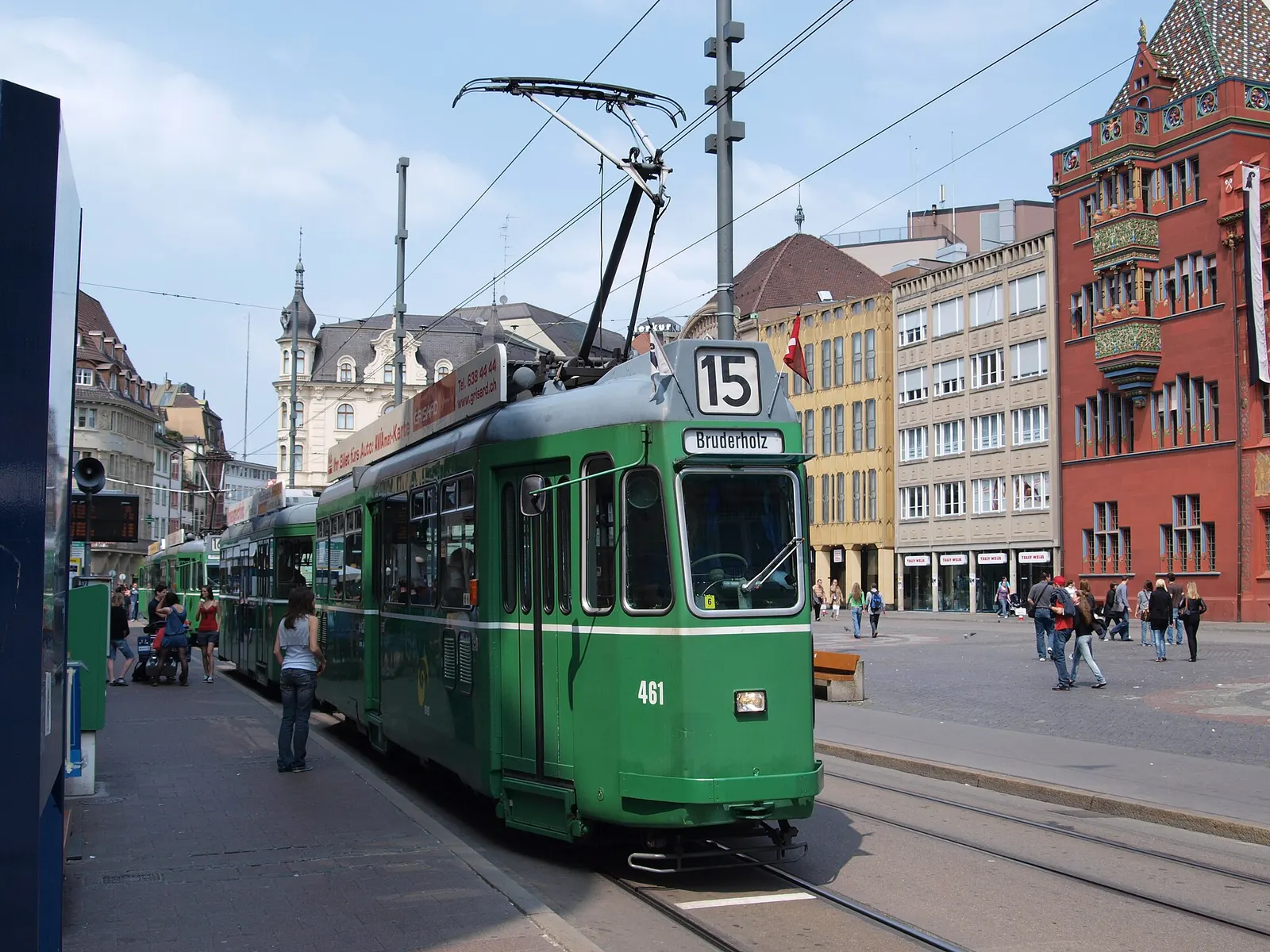
Student cities in Switzerland compared
| City | Canton and official language | Residents | Universities | Student housing body |
|---|---|---|---|---|
| Zurich | Zurich; German | 440,935 | ETH Zurich, University of Zurich, and universities of applied sciences, arts and teacher education | WOKO |
| Lausanne | Vaud; French | 145,596 | EPFL, University of Lausanne, and the Vaud schools of the HES-SO | FMEL |
| Basel | Basel-Stadt; German | 180,097 | University of Basel; the FHNW is the region's university of applied sciences | WoVe |
| Bern | Bern; the canton has two official languages, German and French; the city's forms for students are German | 138,562 | University of Bern, Bern University of Applied Sciences, PHBern | None citywide; independent providers |
The population figures use the Federal Statistical Office's definition for all four cities so that they can be compared; the cities' own registers count more people. Other cities with a university on swissuniversities' list of accredited institutions, such as Geneva, Fribourg, St. Gallen and Neuchâtel, have no page in this edition of the guide.
- Official languageAmtssprache (langue officielle)
- The language in which the canton's authorities work, laid down in the cantonal constitution. It is German in Zurich and Basel-Stadt and French in Vaud. The canton of Bern has two, German and French, assigned by administrative region: French in the Bernese Jura, both in the Seeland region and the district of Biel/Bienne, and German in the other regions. The constitution does not name the city of Bern; what the University of Bern reports is that the city's forms for students exist only in German.
Language first: German-speaking or French-speaking
A master's taught in English does not make the city English-speaking. The authorities work in the canton's official language, so expect the forms and letters of the offices in German or French. The City of Bern's registration form for non-EU nationals, for instance, exists only in German according to the University of Bern, and the City of Lausanne publishes its registration procedure for students in French. swissuniversities' portal for international students says that all Swiss universities require a good knowledge of the language of instruction and that most offer free language courses in the national languages and English to enrolled international students. Which language each programme needs is covered in language requirements, and the English-taught offer in English-taught master's programmes.
- Swiss GermanSchweizerdeutsch
- The dialects spoken in everyday life in German-speaking Switzerland. swissuniversities' portal lists the Swiss German dialect next to German, French, Italian and Romansh among the languages you can pick up while studying here.
What each city costs, according to its own university and canton
No official body publishes one comparable cost-of-living figure per city. What exists are estimates by each university, the amount each canton or university names as proof of means for the permit, and the average health-insurance premium per canton. They are not built the same way, so read each cell with its label and use the cost-of-living article for how they are composed.
| Zurich | Lausanne | Basel | Bern | |
|---|---|---|---|---|
| University's living-cost estimate | University of Zurich: at least CHF 2,200 per month, study costs included. ETH: about CHF 22,100 per year | EPFL budget for foreign students: CHF 2,107 per month without tuition. UNIL: about CHF 2,000 per month | University of Basel sample budget: CHF 2,000 to CHF 2,100 per month, study costs included | University of Bern: CHF 1,500 to CHF 2,200 per month |
| Proof of means named for the permit | CHF 21,000 for twelve months (canton) | CHF 2,000 per month (as stated by EPFL) | CHF 2,000 per month (canton) | At least CHF 18,000 (University of Bern, for regular degree students; the canton names no amount) |
| Mean health premium 2027, ages 19 to 25 | CHF 333.80 per month | CHF 382.10 per month | CHF 408.50 per month | CHF 336.70 per month |
| Transport pass under 25, per month, price lists valid from 13 December 2026 | CHF 66 (ZVV, city zone) | CHF 57 (Mobilis, two zones) | CHF 57 (U-Abo, whole network; price list unchanged since December 2023) | CHF 62 (Libero, zones 100/101) |
| Tuition and compulsory fees per semester | ETH fee group 2: CHF 2,264. University of Zurich, foreign master's students: CHF 879 | EPFL, students subject to the tripled fee: CHF 2,240. UNIL: CHF 580 | University of Basel semester fee: CHF 850 | University of Bern, international students: CHF 2,609 |
The four cities in a paragraph each
Zurich
The largest city, with both ETH Zurich and the University of Zurich. Student rooms are let by the cooperative WOKO, whose page points master's students newly arriving from abroad to a separate room offer of the universities, and ETH describes the housing market as extremely sparse. Arrivals from abroad register in person, by appointment, at one office. Continue with studying in Zurich, ETH Zurich and the University of Zurich.
Lausanne
The French-speaking city of the four and the capital of the canton of Vaud, with EPFL and the University of Lausanne on neighbouring campuses. The foundation FMEL houses bachelor's and master's students and states that students who already have a master's degree are not entitled to book. Students register online with the city. Continue with studying in Lausanne and EPFL.
Basel
A city-canton in the north-west whose official language is German, with one university; its regional pass is also recognised in neighbouring German towns and on a French bus network. WoVe lets furnished and unfurnished rooms to anyone in full-time education, and residents under 25 whose tax domicile is in the canton can buy the regional pass at a reduced annual price. Continue with studying in Basel.
Bern
A city in a canton with two official languages, German and French, where the forms a student meets are German. It has one university, which charges international students an additional tuition fee. There is no single housing body: the university lists independent providers. Non-EU students register with the city's migration office by e-mail or post. Continue with studying in Bern.
What is the same in every city
- The visa and permit procedure follows federal law, with the canton deciding. You register within 14 days of entry in the commune where you live: visa and residence permit.
- Health insurance must be taken out within 3 months of registering your residence, unless the canton grants an exemption: health insurance for international students.
- Side jobs follow the federal rule: as a rule none in the first 6 months (SEM's directive makes one exception, for master's students with a foreign bachelor's degree who work at their university's own institute), then at most 15 hours per week during the semester, and always with an authorisation for each job: how many hours international students can work and working as a student.
- Tenancy law is federal: the deposit cap and notice periods in student accommodation apply in all four cities.
- The youth price of every transport pass on this page ends on the 25th birthday. A master's student who is 25 or older pays the adult price. Three of the four networks have published price lists valid from 13 December 2026, and those are the prices shown here.
How to choose between them
Start from the programme
List the master's programmes you qualify for and that are taught in a language you can study in. That usually leaves one or two cities. The admission rules are in how to apply to Swiss universities.
Check the fee that applies to you
The two federal institutes and some cantonal universities charge students from abroad more, each under its own definition. Compare the row for your case, not the headline fee.
Check housing eligibility
See whether the city's housing body accepts your situation (new arrival from abroad, second master's, age). The rules are in student housing.
Check the proof of means
The amount named for the permit differs between cantons, and you must be able to show it before the visa is issued.
Decide how much of the local language you want to learn
English-taught master's programmes exist in all four cities, but the authorities work in German or French, and so will much of your paperwork.
If you are still at the stage of deciding whether Switzerland is feasible at all, go back to the main guide and its step-by-step plan.
Frequently asked questions
Which Swiss city is best for international students?
There is no official ranking, and the right city follows from the programme you are admitted to. Zurich and Lausanne host the two federal institutes of technology and the housing bodies WOKO and FMEL; Basel and Bern each have one university. Compare language, fees for your case, housing eligibility and the proof of means the canton asks for.
Is Zurich or Lausanne better for a master's in English?
The teaching language is set programme by programme at both ETH Zurich and EPFL, so the decision rests on the programme you are admitted to. Outside the campus, the offices in Zurich work in German and those in Lausanne in French: their forms and letters come in that language.
Which is the cheapest student city in Switzerland?
No official source compares the four on one basis. The universities' own estimates range from CHF 1,500 per month at the lower end of the University of Bern's estimate to CHF 2,200 per month as the University of Zurich's minimum, but they do not include the same items.
Do I need German to study in Zurich, Basel or Bern?
Not for an English-taught master's, if the programme's own language rules say so. You will meet German in daily administration: German is an official language of all three cantons, and for example Bern's registration form for non-EU nationals is available only in German.
Why is Geneva not in this guide?
This first edition covers Zurich, Lausanne, Basel and Bern. Geneva and the other university cities have no page yet, so nothing is stated about them here.
Sources
24 sources, 21 official
- Demographic balance by institutional units (STAT-TAB table px-x-0102020000_201): population on 31 December 2025 by communeFederal Statistical Office (FSO) (Official)
- Verfassung des Kantons Zürich vom 27. Februar 2005 (SR 131.211), Art. 48Swiss Confederation (Fedlex) (Official)
- Constitution du Canton de Vaud du 14 avril 2003 (RS 131.231), art. 3 (langue officielle) et art. 4 (capitale)Swiss Confederation (Fedlex) (Official)
- Verfassung des Kantons Basel-Stadt vom 23. März 2005 (SR 131.222.1), § 76Swiss Confederation (Fedlex) (Official)
- Verfassung des Kantons Bern vom 6. Juni 1993 (SR 131.212), Art. 6Swiss Confederation (Fedlex) (Official)
- Accredited Swiss Higher Education Institutionsswissuniversities (Official)
- Tuition Languagesswissuniversities (Study in Switzerland+) (Official)
- Zuzug aus dem Ausland in die Stadt ZürichStadt Zürich, Personenmeldeamt (Official)
- Information and recommendations for visa application (factsheet for regular incoming non-EU/EFTA students)University of Bern, UniBE International (Official)
- Etudiant·e·s: Annonce d'arrivée et formalités de séjourVille de Lausanne, Service du contrôle des habitants (Official)
- Zuzug in den Kanton Basel-StadtKanton Basel-Stadt, Einwohneramt (Official)
- Conditions relevant to entering and residing in SwitzerlandUniversity of Bern (Official)
- Tickets and Prices, valid from 14.12.2025 (product rules; prices until 12 December 2026)Zürcher Verkehrsverbund (ZVV) (Official)
- Preise ab 13.12.2026 (ZVV-Verbundtarif 2027, Ziff. 1.4 Monatsabonnemente, Jahresabonnemente)Zürcher Verkehrsverbund (ZVV) (Official)
- Mobilis rates (tickets and subscriptions)Mobilis, Communauté tarifaire vaudoise (Official)
- Grille tarifaire dès le 13 décembre 2026Mobilis, Communauté tarifaire vaudoise (Official)
- U-AboTarifverbund Nordwestschweiz (TNW) (Official)
- Libero Abo für Bern: Infos & Preise (zones 100/101)Tarifverbund Libero (Official)
- Libero-Prospekt 2027: Alle Fahrausweise und Preise auf einen Blick (gültig ab 13.12.2026)Tarifverbund Libero (Official)
- Wer ist mietberechtigt?WOKO Studentische Wohngenossenschaft Zürich (Institutional)
- Book your FMEL accommodationFondation Maisons pour Etudiants Lausanne (FMEL) (Institutional)
- Dein neues Zuhause Schritt für SchrittVerein für Studentisches Wohnen (WoVe), Basel (Institutional)
- Accommodation - livingUniversity of Bern (Official)
- Accommodation (after admission, international students)ETH Zurich (Official)