An EPFL master's is an engineering, science, architecture or technology-management degree at the federal institute of technology in French-speaking Switzerland. Compared with ETH Zurich it gives you a second application deadline, no compulsory language certificate and a campus on Lake Geneva; in return you live in a French-speaking region, where the commune and the canton deal with you in French, and for some programmes EPFL recommends a good command of French.
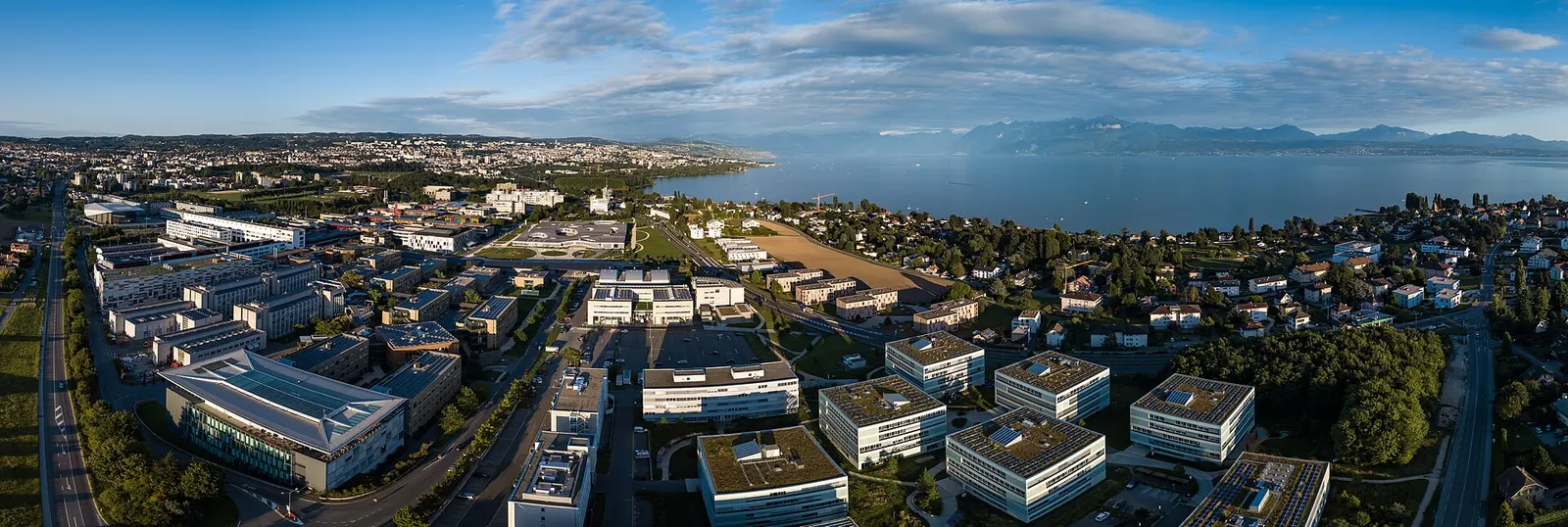
Like ETH Zurich, EPFL is run by the Confederation, so its tuition and admission rules are federal. The residence permit, the proof of financial means and the health-insurance exemption are matters for the Canton of Vaud and your commune. The universities overview explains the two federal institutes and how they differ from the cantonal universities.
EPFL at a glance
| Item | What EPFL states |
|---|---|
| Origins | First classes in 1853 as the private École spéciale de Lausanne; a federal institute of technology since 1 January 1969 |
| Type | Federal institute of technology (École polytechnique fédérale) |
| Students, autumn 2025 | 14,072 students, of whom 4,471 master's students |
| Foreign students, autumn 2025 | 54.8% of the student population |
| Structure | 5 schools and two colleges |
| Master's programmes | 29 master's programmes, of which 7 specialised programmes |
| Length of a master's | 90 or 120 ECTS credits: a master's cycle of 60 or 90 credits, then a one-semester master's project of 30 credits |
| Main campus | Ecublens, on Lake Geneva west of Lausanne; first buildings inaugurated in 1978 |
| Other sites | EPFL is active in 5 cantons: Vaud, Geneva, Valais, Fribourg and Neuchâtel |
- Federal institute of technologyÉcole polytechnique fédérale (EPF)
- One of the two universities run by the Confederation instead of a canton. In German the same type is the Eidgenössische Technische Hochschule (ETH), which is why the Zurich institute is called ETH and the Lausanne institute EPFL.
Master's programmes and their teaching languages
EPFL publishes one table of all its master's programmes with credits, teaching languages and the professional title each leads to. On 17 November 2026, 16 programmes were listed with English as the only teaching language; the others were listed with English and French. Where both languages are listed, EPFL adds a note saying which one you should command well. EPFL's general statement is that most master's programmes are taught mainly in English and others mainly in French.
| School or college | Programmes | Language as listed |
|---|---|---|
| Architecture, Civil and Environmental Engineering (ENAC) | Architecture; Civil Engineering; Environmental Engineering; Urban Systems | English and French. For Architecture, Civil Engineering and Urban Systems EPFL recommends a good command of French |
| Engineering (STI) | Electrical and Electronic Engineering; Energy Science and Technology; Materials Science and Engineering; Mechanical Engineering; Microengineering; Robotics | English and French, with a good command of English recommended |
| Computer and Communication Sciences (IC) | Computer Science; Cyber Security; Data Science; Digital Humanities | English |
| Basic Sciences (SB) | Applied Mathematics; Mathematics; Statistics; Applied Physics; Physics; Chemical and Biological Engineering; Molecular and Biological Chemistry; Computational Science and Engineering; Nuclear Engineering | English for most; English and French for Applied Mathematics, Mathematics and Statistics |
| Life Sciences (SV) | Life Sciences Engineering | English |
| College of Management of Technology (CDM) | Financial Engineering; Management, Technology and Entrepreneurship; Sustainable Management and Technology | English |
| Cross-school programmes | Neuro-X; Quantum Science and Engineering | English |
All programmes are 120 ECTS credits in that table except Mathematics, which is 90. Two programmes, Cyber Security and Nuclear Engineering, carry the professional title 'EPF-ETH qualified Engineer' in that table. Inside a programme you can group courses into an orientation, a specialisation or a minor; a specialisation and a minor each correspond to 30 credits, and EPFL notes the specialisation in the Diploma Supplement.
- Master's projectprojet de master
- The one-semester thesis of 30 ECTS credits that ends every EPFL master's programme, after the master's cycle of courses and semester projects.
- Minormineur
- A set of compulsory and optional courses worth 30 ECTS credits taken from one or more other master's programmes, to add a second field to your main discipline. In Management, Technology and Entrepreneurship a minor is mandatory.
Admission with a foreign bachelor's degree
EPFL states that holders of a university bachelor's degree in a related field may apply, that admission is competitive and that foreign degrees are decided case by case. You may apply to one programme per academic year, and the decision is valid only for the following academic year. EPFL does not consider applicants who already hold a master's degree in the same or a similar field. The requirements are compared with those of the other universities in master's requirements and recognised degrees.
| Point | EPFL's rule |
|---|---|
| First deadline | 15 December, with the application open from mid-November; decisions in late March |
| Second and last deadline | 31 March; decisions in mid-June |
| Application fee with a foreign bachelor's degree | CHF 150, not refunded |
| References | Contact details of 3 academic referees, who upload their letters themselves; at least 2 reference letters must arrive |
| Statement of purpose | At most 1,000 words |
| Proof that the bachelor's degree is complete | By 30 September, otherwise the admission is cancelled |
| Start of studies | Early September of the same year, for both deadlines |
What it costs and how it can be funded
From the autumn semester 2025 EPFL charges the tripled tuition fee to foreign students who take up residence in Switzerland for the purpose of studying; Swiss nationals and people who live in Switzerland for another reason pay the standard fee. EPFL's definition is its own decision and is not word for word the same as ETH Zurich's: read both in tuition fees in Switzerland.
| Item | Amount | Whose figure |
|---|---|---|
| Tuition | CHF 2,190 per semester | EPFL tuition fee page |
| Other fees on the semester invoice | CHF 50 per semester | Student association, sports facilities, social fund |
| Semester invoice in total | CHF 2,240 per semester | EPFL tuition fee page |
| Living costs | CHF 2,107 per month | EPFL's approximate budget for a foreign student, without tuition |
| Living costs over twelve months | CHF 25,219 per year | The same budget, per year |
EPFL's own award for master's students is the Master Excellence Fellowship of CHF 10,000 per semester, for up to 4 semesters. Holders pay their own tuition and rent, so it does not make the degree free. You ask for it inside the master's application, which must be paid and validated by 15 December to be considered. The Swiss Government Excellence Scholarships do not fund a regular master's. See university scholarships in Switzerland and the cost of living for students, city by city.
Campus, language of daily life and housing
The main campus is in Ecublens, on what EPFL describes as the north side of Lake Geneva. The institute was relocated to this purpose-built site from the city of Lausanne; the first buildings were inaugurated in 1978. A building project in the middle of the campus, the transformation of the Esplanade, changes routes on site until 2029, and EPFL recommends its 'EPFL Campus' app to find your way and public transport to get there.
Housing in the Lausanne area is run mainly by the foundation FMEL, whose printed rents run from CHF 470 for a single room to CHF 1,230 per month for a flat on its own pages. Read its eligibility rules before you count on it: FMEL does not house students who already hold a master's degree. The routes, the deposit and the private market are in student housing in Switzerland; the city, its registration office and its transport pass are in studying in Lausanne.
In practice: from the admission letter to the first week
The dates below are those EPFL published for the intake of autumn 2026; they show the rhythm of the weeks before classes begin. Check the page 'New Master students' for your own year.
After admission
Visa and proof of means
Apply for the national (D) visa as soon as you hold the admission letter. EPFL tells its students that the Canton of Vaud expects proof of CHF 2,000 per month. See the student visa and proof of financial means.
During the summer
EPFL account
You receive your EPFL user name and password, which give access to secured EPFL services such as your mailbox and the Moodle learning platform.
17 to 28 August 2026
Intensive French course
Two weeks on campus before the academic year; registration closed several weeks earlier.
1, 2 and 3 September 2026
Matriculation days
Students with a foreign diploma matriculate in person, in the morning, in a time slot they must reserve. This is also where you receive the CAMIPRO student card.
Friday, 4 September 2026
Welcome Day
Mandatory for new students: campus, programme and services are presented.
Monday, 7 September 2026
Classes start
In IS-Academia you validate your personal data in the academic registration form (FRAC) and register for your courses, both by 18 September 2026.
Within 14 days of arrival
Register with your commune
The residence permit starts with the registration: see the student residence permit. Health insurance must be arranged within 3 months of registering: see health insurance for international students.
- Student card. The CAMIPRO card must be updated every semester at a CAMIPRO terminal.
- Enrolment certificate. It appears in IS-Academia once you have validated your personal data and EPFL has received the payment of the semester fees. You will need it for the canton and for the yearly permit extension.
- Where to ask. EPFL calls the Student Services desk in the BP building its main contact point for students' queries: open in person from Monday to Friday, 9 am to 5 pm, and reachable by e-mail and telephone.
- No double matriculation. EPFL does not allow you to be matriculated there and at another university at the same time, except in an official double-degree programme. If you had begun studies elsewhere, EPFL asks for proof that you are no longer matriculated there, otherwise the admission is cancelled.
Before you apply to EPFL
- The programme's line in EPFL's overview table read: credits, teaching languages and the language note
- Deadline chosen: 15 December if you need a visa or want to be considered for the fellowship
- 3 academic referees asked and told that they upload their letters themselves
- Statement of purpose within 1,000 words
- Transcripts and degree documents in English, French, German or Italian, or with the translation EPFL accepts
- Funding plan for tuition and CHF 25,219 of living costs a year, including how you will prove means to the canton
Working while you study
The rule is federal and the same in Lausanne as in Zurich: a side job needs an authorisation, at the earliest 6 months after the start of the studies, for up to 15 hours per week outside the holidays, on an application by the employer. The exception for master's students who work at their own institute, and what applies after graduation, are in how many hours international students can work and staying in Switzerland after graduation.
Frequently asked questions
Is EPFL taught in English or French at master's level?
Both. In EPFL's programme table on 17 November 2026, 16 programmes of its 29 master's programmes listed English as the only teaching language and the others listed English and French. For Architecture, Civil Engineering and Urban Systems EPFL recommends a good command of French.
When is the EPFL master's application deadline?
There are two: 15 December and 31 March, both for a start the following September. EPFL strongly advises applicants who need a visa to use the first one, and only the first one counts for the Master Excellence Fellowship.
Does EPFL require IELTS or TOEFL for a master's?
No certificate is compulsory. EPFL recommends level C1 in the teaching languages and says TOEFL and GRE results are welcome but not required. That is EPFL's rule only: ETH Zurich and the University of Zurich require a recognised certificate, with narrow exemptions of their own.
How much does EPFL cost for international master's students?
Foreign students who move to Switzerland to study pay CHF 2,190 per semester in tuition, and CHF 2,240 per semester with the other fees on the invoice. EPFL's budget for living costs is CHF 2,107 per month without tuition.
Can I apply to more than one master's programme at EPFL?
No. EPFL accepts one application for one programme per academic year, and an admission is valid only for the next academic year.
Can I get into EPFL's master's with a bachelor's degree from Türkiye?
You may apply with a university bachelor's degree in a related field; EPFL decides foreign degrees case by case and may ask for supplementary credits. Degrees from programmes shorter than three years or from non-university institutions do not qualify, according to EPFL's admission FAQ.
Sources
22 sources, 20 official
- About EPFLEPFL (Official)
- History of EPFLEPFL (Official)
- EPFL en chiffres 2025 / EPFL in figures 2025EPFL (Official)
- Master (Education)EPFL (Official)
- Programs overview (Master's)EPFL (Official)
- Study programs structure (Master's)EPFL (Official)
- Associated campusesEPFL (Official)
- New Master students (Prepare yourself for EPFL)EPFL (Official)
- Welcome day for new studentsEPFL (Official)
- Student services (Student Services desk)EPFL (Official)
- Academic calendarEPFL (Official)
- Master admission criteria & applicationEPFL (Official)
- Online application (Master)EPFL (Official)
- Teaching languagesEPFL (Official)
- Frequently asked questions (Admission)EPFL (Official)
- Tuition fee and other feesEPFL (Official)
- Financing your studiesEPFL (Official)
- Master excellence fellowshipsEPFL (Official)
- Master excellence fellowships: Application & deadlinesEPFL (Official)
- Visa (Immigration formalities)EPFL (Official)
- FAQFondation Maisons pour Etudiants Lausanne (FMEL) (Institutional)
- Our houses (rents are on each house's page, linked from here)Fondation Maisons pour Etudiants Lausanne (FMEL) (Institutional)