A master's at the University of Zurich is the choice for subjects that the federal institutes of technology do not teach, or teach differently: law, economics and business, medicine, the humanities and social sciences, alongside the natural sciences, mathematics and informatics. For a student from abroad, tuition is far lower than at ETH Zurich in the same city, and the price of that breadth is language: many programmes are in German, and UZH requires certified proof of the language of instruction.
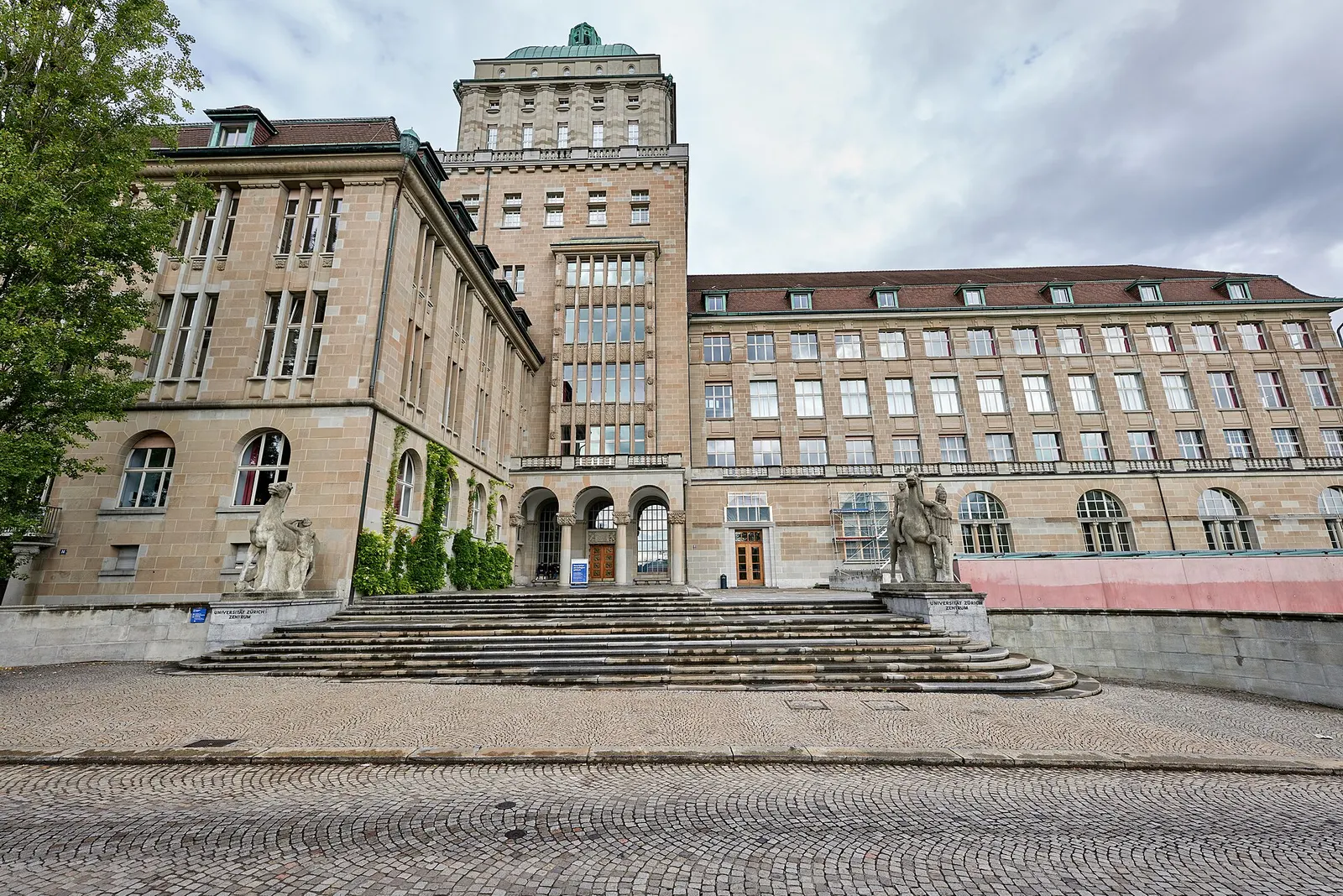
UZH is a cantonal university: the Canton of Zurich is responsible for it, and its additional fee for foreign students rests on a cantonal ordinance. The same canton's migration office decides your residence authorisation. If you are comparing it with its neighbour, read the ETH Zurich page next: the two share a city, a sports association and a housing office, and little else in how you apply or what you pay.
The University of Zurich at a glance
| Item | What UZH states |
|---|---|
| Founded | 1833 |
| Type | Cantonal university (Canton of Zurich); UZH calls itself Switzerland's largest university |
| Students, start of the Fall Semester 2026 | 29,037 students (provisional figure, data of 14 September 2026) |
| Students, 2025 | 28,785 students at bachelor's, master's and PhD level |
| Students who come from abroad, Fall Semester 2026 | 19.6% (provisional) |
| Faculties | 7 faculties |
| Campuses | City, Irchel, Oerlikon and Schlieren |
| Teaching language | Bachelor's programmes: German. Master's programmes: German or English as the main language for most; French, Italian or Spanish for some programmes in language and literature |
| Length of a master's | 90, 120, 150 or 180 ECTS credits, depending on the programme |
| Faculty | UZH's heading |
|---|---|
| Faculty of Theology and the Study of Religion | On Faith and Religion |
| Faculty of Law | Law and Legislation |
| Faculty of Business, Economics and Informatics | How the Markets Work |
| Faculty of Medicine | In the Service of Health |
| Vetsuisse Faculty | Medicine for Animals and Humans |
| Faculty of Arts and Social Sciences | People, Culture and Society |
| Faculty of Science | What is Life, What is Matter |
UZH's list of master's study programmes can be filtered by eight topics: social sciences; law and economics; linguistics and literature; natural sciences; mathematics and computer sciences; history and cultural studies; medicine and healthcare; theology and religious studies. The list mixes German and English names, for example Rechtswissenschaft, Psychologie, Betriebswirtschaftslehre and Geschichte beside Data Science, Artificial Intelligence, Finance, Biology and Physics. A name is not a statement about the teaching language: confirm the main language of instruction on the programme's own page. UZH's pages give different totals for the number of master's study programmes, so this guide states none; the programmes in Scholway's catalogue are counted in English-taught master's programmes in Switzerland.
How a UZH master's is built: single major, major and minor
A UZH degree programme is either one study programme on its own or a combination of a major with a minor. That structure is unusual for readers who know one-subject master's degrees, and it matters at application: you are admitted to study programmes, and the requirements are checked for each.
- Single majorMono-Studienprogramm
- A degree programme in which only one subject is studied. A single-major master's at UZH comprises 90, 120, 150 or 180 ECTS credits.
- Major and minor
- A combined programme: the major generally makes up at least two thirds of the course load, 90 credits at master's level, and the minor comprises 30 credits. The major decides which faculty you belong to, the study programme regulations say which combinations are possible, and the minor can generally be taken at another faculty.
- Consecutive, specialised and complementary master'skonsekutiver / spezialisierter Master
- UZH names three kinds of master's study programme: consecutive ones, which build on the bachelor's in the same subject; specialised ones, with a specialised or interdisciplinary focus; and complementary ones, which need no prior knowledge of the subject and are offered as minors only.
One ECTS credit stands for roughly 30 hours of work, and a full-time student earns about 30 credits a semester. UZH describes itself as a university of in-person teaching: selected courses are recorded, but in many modules attendance is part of the assessment.
Admission with a foreign bachelor's degree
UZH checks two things. Formally, your bachelor's degree must come from a state-recognised university, represent at least three years of study and entitle you to a consecutive master's in the country that issued it. Academically, the faculty compares its content with what the study programme requires and may set additional requirements; if these come to more than 60 ECTS credits in total, admission is refused. The rules, and how they compare with the other universities, are in master's requirements and recognised degrees.
| Point | UZH's rule |
|---|---|
| Fall semester, applicants who need a visa | 1 January to 28 February |
| Fall semester, applicants who do not need a visa | 1 January to 30 April |
| Spring semester, applicants who need a visa | 1 July to 31 July; several programmes start in the fall only |
| Application fee with foreign qualifications | CHF 150, not refunded |
| Applications per semester | As a rule, one per person |
| Review of a complete dossier | Generally up to 3 months |
| Bachelor's diploma, if not yet issued when you apply | By 30 September for a start in the fall semester |
| English-taught programmes: language proof | IELTS Academic 7 or an equivalent listed certificate, no older than 2 years |
What it costs and how it can be funded
Under the cantonal ordinance, UZH's additional fee is owed by foreign students who did not have their legal residence in Switzerland or Liechtenstein when they gained their university entry qualification. A Turkish citizen who finished school in Türkiye is therefore subject to it; a foreign national who finished school in Switzerland is not. At master's level it is the lower of the ordinance's two rates. The ordinance, the bachelor's surcharge and the comparison with ETH are in tuition fees in Switzerland.
| Item | Amount | Whose figure |
|---|---|---|
| Tuition | CHF 720 per semester | UZH fees page |
| Additional fee for foreign students, master's level | CHF 100 per semester | Cantonal ordinance, UZH fees page |
| Mandatory semester contributions | CHF 59 per semester | UZH fees page |
| Total | CHF 879 per semester | Sum of the three lines, without voluntary contributions |
| Minimum budget for living and studying | CHF 2,200 per month | UZH guideline; it adds that international students will probably have additional costs |
Do not plan on a UZH scholarship. The university says that master's students with a bachelor's degree from abroad must finance their studies themselves, and the Swiss Government Excellence Scholarships do not fund a regular master's. What does exist is listed in university scholarships in Switzerland. For the permit, the Canton of Zurich counts CHF 21,000 for twelve months as sufficient means, which is a separate question from what life in Zurich costs: see proof of financial means and the cost of living for students.
Four campuses and where to live
UZH has around 40 buildings on its City Campus in the heart of Zurich, more than 30 at the Irchel Campus in the north of the city next to Irchel Park, and eight more on smaller sites in Oerlikon and Schlieren. Find out where your study programme is taught before you look for a room. A room is not part of the admission: the routes are the Housing Office of the University and ETH, which runs a search portal for private offers and allocates flats, studios and rooms to foreign students and academic guests; the student housing body WOKO, whose property overview prints rents from CHF 225 to CHF 1,458 per month across all its properties (the lowest figure belongs to a property in Winterthur and the highest to one in Zollikon, both outside the city of Zurich), and which has its own eligibility rules; and the private market. They are described in student housing in Switzerland, and the city in studying in Zurich.
In practice: the academic year and your first steps
| Semester | Semester runs | Lectures |
|---|---|---|
| Fall Semester 2026 | 1 August 2026 to 31 January 2027 | 14 September to 19 December 2026 |
| Spring Semester 2027 | 1 February to 31 July 2027 | 22 February to 4 June 2027 |
| Fall Semester 2027 | 1 August 2027 to 31 January 2028 | 20 September to 23 December 2027 |
Choose with the Master Days in mind
UZH holds information events on its master's programmes every spring semester; the next are announced for March 2027. By then the fall window for applicants who need a visa has already closed, so use them for the following year or study the programme pages online.
Check whether your programme wants a pre-registration
Several specialised master's programmes ask you to register with the department before the central application. The programme page says so.
Apply in the visa window
Submit the complete dossier, with the language certificate, within 1 January to 28 February for the fall semester.
Apply for the visa as soon as you are admitted
UZH tells students to submit the visa application with all documents at least 3 months before the planned entry: see the student visa step by step.
Register after arrival
Register at the residents' registration office of your place of residence within 14 days; the City of Zurich charges CHF 40 per adult to register, plus CHF 124 to CHF 144 in migration office fees for an adult from a non-EU/EFTA state, depending on the type of permit (the city gives these figures as an orientation). See the student residence permit.
Arrange health insurance
Within 3 months of registering, either join a Swiss insurer or apply to the canton for an exemption with a recognised student insurance: see health insurance for international students.
- Advice. The Student Advisory Services help enrolled students with questions that cross subjects or faculties; each faculty and department also runs its own advisory office for its study programmes.
- Money. The Student Financial Aid Office is UZH's first contact for questions about financing your studies and helps with a realistic budget.
- Libraries. The University Library and the Zentralbibliothek Zürich serve UZH students.
- Confirmation of enrolment. The Zurich migration office wants a current one with each permit extension; UZH's registry issues it for CHF 10.
Before you apply to the University of Zurich
- Main language of instruction of your study programme confirmed on its own page
- Certificate at the required level booked in a format UZH accepts, dated within 2 years
- Single major or major-minor combination decided, and the requirements of each study programme read
- Pre-registration with the department done, if your programme asks for it
- Calendar set to the visa window, 1 January to 28 February, not to the general deadline
- Budget of at least CHF 2,200 a month planned, and proof of means for the canton prepared
Working while you study
The federal rule applies at UZH as everywhere: a side job needs an authorisation, at the earliest 6 months after the start of the studies and for up to 15 hours per week outside the holidays. Details and the exception for master's students working at their own institute are in how many hours international students can work.
Frequently asked questions
Does the University of Zurich teach master's programmes in English?
Yes, a part of them. UZH states that the main language of instruction for most master's study programmes is either German or English, and for some programmes in language and literature French, Italian or Spanish. All its bachelor's programmes are taught mainly in German.
What is the University of Zurich application deadline for international students?
For the fall semester, applicants who need a visa apply in 1 January to 28 February; for those who do not need one the window is 1 January to 30 April. UZH states that the deadlines cannot be extended.
How much are tuition fees at the University of Zurich for international master's students?
Tuition is CHF 720 per semester, plus CHF 100 for foreign master's students who had their legal residence outside Switzerland and Liechtenstein when they gained their university entry qualification, plus mandatory contributions: CHF 879 per semester in total.
Does the University of Zurich accept a bachelor's degree from Türkiye for a master's?
It can: the degree must be from a state-recognised university, cover at least three years and entitle you to a master's in Türkiye, and the faculty then checks its content against the programme. If the additional requirements exceed 60 ECTS credits, admission is refused. There is no general recognition; UZH decides each application.
Is the University of Zurich the same as ETH Zurich?
No. UZH is a cantonal university with seven faculties, including law, medicine and the humanities; ETH Zurich is a federal institute of technology. They have different application windows, language rules and tuition fees.
Can I start a master's at the University of Zurich in the spring semester?
Some programmes can be started in spring, but several start in the fall only. The spring window for applicants who need a visa is 1 July to 31 July, half a year before the semester begins.
Sources
23 sources, 22 official
- At a GlanceUniversity of Zurich (Official)
- FiguresUniversity of Zurich (Official)
- Profile of the University of ZurichUniversity of Zurich (Official)
- Faculties and InstitutesUniversity of Zurich (Official)
- CampusesUniversity of Zurich (Official)
- Basic Principles (Academic Programs)University of Zurich (Official)
- Master's Study ProgramsUniversity of Zurich (Official)
- Master Information DaysUniversity of Zurich (Official)
- Study at UZH (UZH for International Students and Scholars)University of Zurich (Official)
- Semester DatesUniversity of Zurich (Official)
- Services and advice for studentsUniversity of Zurich (Official)
- Admission to the Master's ProgramUniversity of Zurich (Official)
- Application DeadlinesUniversity of Zurich (Official)
- Language RequirementsUniversity of Zurich (Official)
- Fees and ContributionsUniversity of Zurich (Official)
- Fees and ContributionsUniversity of Zurich (Official)
- Ordinance Governing Additional Fees for Foreign Students at UZH (LS 415.322), dated 1 February 2012 (English translation, PDF)Canton of Zurich, Government Council (published by the University of Zurich) (Official)
- Tuition & Cost of LivingUniversity of Zurich, Student Financial Aid Office (Official)
- FinancesUniversity of Zurich (Official)
- Leitfaden für Studierende mit VisumspflichtUniversity of Zurich (Official)
- Nach der EinreiseUniversity of Zurich (Official)
- About us: Housing Office of University / ETH ZurichHousing Office of the University of Zurich and ETH Zurich (Official)
- Wer ist mietberechtigt?WOKO Studentische Wohngenossenschaft Zürich (Institutional)