A non-EU graduate has a 12 months extension of the student permit in which to find a qualifying job, and the usual destination is the Red-White-Red Card for graduates. Both are covered in the job-seeker guide and the Red-White-Red Card guide. This guide is about the market itself: which occupations official sources point to, how much German to plan for, where to search, and which pay figures are reliable. It builds on the student jobs guide, which covers CVs and scams.

Where official sources point to demand
- Shortage occupationMangelberuf
- An occupation the state lists because positions are hard to fill. Listed occupations open the skilled-worker route (§ 12a AuslBG) without a labour-market test.
- Skilled Workers RegulationFachkräfteverordnung
- The annual ordinance that fixes the list. The 2026 version (BGBl. II Nr. 316/2025) applies from 1 January to 31 December 2026 and is replaced each year. § 1 (1) lists 64 occupations Austria-wide; § 1 (2) adds occupations for employers in individual provinces.
Two official instruments help here. The ordinance is a legal list, and the AMS JobBarometer is an information system on occupation and skill trends built from online job advertisements, with forecasts and outlooks added; you can browse occupations on it. Neither tells you how many vacancies exist in your field. The ordinance is a permit tool: it names occupations where the state allows the points-based shortage route, which needs 55 points. As a graduate you will usually use the graduate route instead, which has no list and no points, but the list shows what the state treats as hard to fill.
| Area | Occupations named | Comment |
|---|---|---|
| Health and care | Ärzt(e)innen; Diplomierte Gesundheits- und Krankenpfleger/innen; Medizinisch-technische Fachkräfte; Pflegefachassistent/in; Pflegeassistent/in | Check whether your qualification needs recognition (nostrification) before you apply |
| Engineering | Diplomingenieur(e)innen für Starkstromtechnik, Maschinenbau, Schwachstrom- und Nachrichtentechnik, technische Physik; Physiker/innen | 'Techniker/innen mit höherer Ausbildung (Ing.)' appear for several fields too |
| IT | Diplomingenieur(e)innen für Datenverarbeitung; Techniker/innen mit höherer Ausbildung (Ing.) für Datenverarbeitung | The ordinance uses the term Datenverarbeitung; ask the employer how your role is classified |
| Education | Elementarpädagog(e)in, including inclusive early-years education | Check whether recognition applies to your teaching qualification |
| Business and administration | Kalkulant(en)innen; Lohn-, Gehaltsverrechner/innen; Techniker/innen für Wirtschaftswesen; Vertriebstechniker/in | Province lists add, for example, social and economic scientists in several provinces |
Most of the remaining entries are trades such as electricians, roofers, welders and carpenters, plus rail operations. Do not read the list as a ranking of the best-paid or most plentiful graduate jobs: it is a legal list fixed each year for permit purposes. The AMS also publishes the series Jobchancen Studium, with career and employment information by field of study for university, Fachhochschule and teacher-education graduates; the 2024 edition is a PDF on ams.at.
How much German to plan for
No official source says how much German employers expect, and what follows is guidance from the immigration rules, not a finding about the market. The graduate route in § 12b Z 2 AuslBG names a qualification-matched job and locally customary pay, and no language level. The points routes award points for German, and for English too. German enters formally later: permanent residence needs Module 2 of the Integration Agreement, which means German at B1 with the values component, and naturalisation needs B1 normally, or B2 (or B1 plus sustained integration) on the six-year route.
| Step | German requirement | See |
|---|---|---|
| Graduate card (§ 12b Z 2 AuslBG) | None named in the statute | Red-White-Red Card |
| Points routes | Points for German and English | Red-White-Red Card |
| Permanent residence | Module 2: B1 with values knowledge | permanent residence |
| Citizenship | B1, or B2 on the six-year route | citizenship |
Where to look
| Channel | Good for | Check |
|---|---|---|
| AMS 'alle jobs' and eJob-Room | Free search across vacancies in Austria, including public administration and some listings from Germany; no registration needed for 'alle jobs' | Filter by qualification and part-time or full-time; confirm the employer will file for the permit |
| University career centre | Jobs, internships and entry-level roles for students and graduates; the University of Vienna also has a graduate tracking programme showing where former students work | Your own university may offer a similar service |
| Employers' career pages and professional networks | Positions that traditional platforms miss; the University of Vienna lists career pages, LinkedIn, newsletters, recommendations and events | Tailor each application to the posting |
| Commercial job boards such as karriere.at, StepStone and Indeed | Volume and filtering by sector and region | Examples only, not endorsements; apply the scam warnings in the student jobs guide |
The University of Vienna advises listing relevant job titles, industries and search terms, because companies use different terms for similar roles; add the German terms for your field. Combine channels: its Career Center says you will not find many suitable positions on traditional platforms alone, and that contacts, conversations and unsolicited applications also open doors.
Pay: the figures you can rely on
No official source gives one graduate salary. What you can rely on are statutory floors and collective-agreement minimums. The Social Affairs Ministry says most collective agreements provide at least €1,700 gross per month, paid 14 times a year, and that agreements, not job titles, set minimum pay by sector; the labour rights guide explains how to look up yours. For the graduate card the AMS compares your offer with the locally customary pay of comparable Austrian graduates.
| Route | Pay requirement | Note |
|---|---|---|
| Graduate card (§ 12b Z 2 AuslBG) | Locally customary pay for comparable Austrian graduates | No euro figure; in practice compare the entry grade of the collective agreement |
| Other key worker | At least €3,465 per month | Gross, plus special payments; also needs points |
| EU Blue Card | At least €55,678 per year | Gross, including special payments; requires a degree of at least three years' study |
These are requirements for permits, not salary benchmarks. A graduate position can pay less than the Blue Card level and still qualify for the graduate card.
How the permit fits into your search
Final semester
Check your degree date and apply for the extension in time; see the job-seeker guide.
Search
Apply to roles matching your qualification; during the extension an employer can obtain a permit for up to 20 hours per week.
Offer
Compare pay with the collective agreement and ask whether the employer will file for the card.
Filing
The AMS confirms the admission criteria within 4 weeks, and the authority decides within 8 weeks of the application; MA 35 Vienna charges €218.
If your best offer is below the graduate-route level, or outside your field, the other routes in the Red-White-Red Card guide and the Blue Card guide may fit. In information and communications technology the Blue Card accepts 3 years of relevant professional experience in place of a degree (§ 12c Abs. 2 AuslBG). A post-degree internship is a job in permit terms; see the internships guide. The overall sequence is in the after-graduation hub.
In practice: a free BIZ visit and the first conversation with an employer
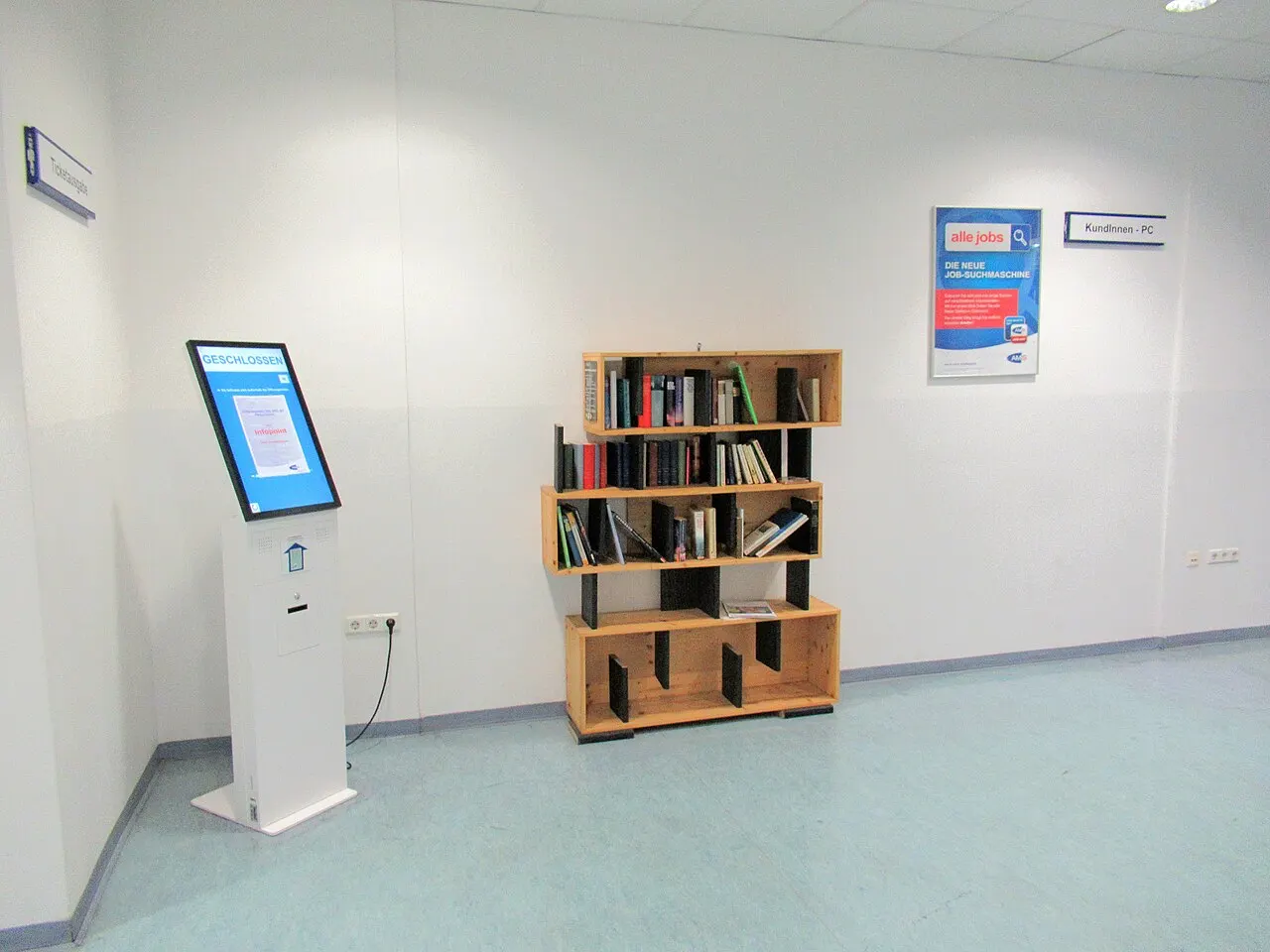
Two low-cost steps help before you send applications. The first is a visit to an AMS BerufsInfoZentrum (BIZ). The AMS runs 73 locations of them and lists self-service computers, career brochures, interest tests and personal advice, in person, by phone or online. At the Villach BIZ the AMS says the services are free, that no registration with the AMS is needed to visit, and that advice appointments can be booked online; hours and booking differ by site, so check the BIZ page nearest you. A BIZ is an information and counselling service, not the place where a permit is decided.
The second is the first call or interview with an employer. For a graduate card the employer's written declaration (Arbeitgebererklärung) is among the documents MA 35 asks for, and the employer can either file the application in writing at the Business Immigration Office or leave you to file in person. Ask three things early, because the answers decide whether the offer can become a card:
- Will the company complete the Arbeitgebererklärung and sign a binding offer? MA 35 lists the declaration with the form, passport, photo and degree proof.
- Which collective agreement and pay group applies? For the graduate card the AMS compares your pay with the locally customary pay of comparable Austrian graduates, so ask for the classification in writing.
- Who files, and when? The company can file for you in writing, or you book an appointment yourself; the steps and the Vienna counter are described in the Red-White-Red Card guide.
After you have the job: changing employer or losing it
A card tied to one employer means a job search does not end with the first contract. Two rules changed on 7 August 2026 (BGBl. I Nr. 81/2026), and both are set out in the Red-White-Red Card guide. They matter when you compare an offer's stability with its pay.
45 days after you apply to change employer
Provisional start
A holder of a title that allows work for one named employer may start with the new employer provisionally 45 days after applying for the change (§ 20d Abs. 2b AuslBG).
At least 6 months from the day unemployment starts
Time to search
The AMS must allow at least 6 months from the start of unemployment before it tells the residence authority that the admission conditions have lapsed (§ 20d Abs. 7 AuslBG).
Frequently asked questions
Which jobs are in demand in Austria for international graduates?
The 2026 shortage-occupation regulation names 64 occupations Austria-wide, including doctors, nurses, medical-technical staff, several Diplomingenieur fields and early-childhood educators, plus many trades. It is a permit list, not a count of vacancies; the AMS JobBarometer shows occupation trends from job advertisements.
Do I need to speak German to get a graduate job in Austria?
The graduate route in the immigration law names a job matching your qualification at locally customary pay and no language level. Whether an employer needs German depends on the role and the team, so read the advertisement and ask. German becomes a formal requirement later, for permanent residence and citizenship.
Where do I find graduate jobs in Austria?
The AMS 'alle jobs' search and eJob-Room are free, and your university's career centre lists entry-level roles. Employers' career pages, LinkedIn and commercial boards such as karriere.at, StepStone and Indeed add volume, and contacts matter as well.
What is the minimum salary for a non-EU graduate?
The graduate card has no euro minimum: the pay must match the locally customary pay of comparable Austrian graduates. Other routes have figures, such as €3,465 per month for other key workers and €55,678 per year for the Blue Card.
Can I work while I search for a job after my degree?
Yes, on the extension of the student permit you can work up to 20 hours per week with an employment permit, without a labour-market test. The job-seeker guide explains the extension.
How is the Austrian shortage list decided and when does it change?
It is fixed each year by ordinance. The 2026 version covers 1 January to 31 December 2026, and applications filed before the end of 2026 are decided under it. A new ordinance replaces it.
Sources
13 sources, all official
- Fachkräfteverordnung 2026 (BGBl. II Nr. 316/2025), § 1 MangelberufeRechtsinformationssystem des Bundes (RIS), Bundeskanzleramt (Official)
- Ausländerbeschäftigungsgesetz § 12b (Sonstige Schlüsselkräfte und Studienabsolventen), Fassung gültig ab 01.10.2022 (BGBl. I Nr. 106/2022)Rechtsinformationssystem des Bundes (RIS), Bundeskanzleramt (Official)
- Ausländerbeschäftigungsgesetz § 20d (Zulassungsverfahren für „Rot-Weiß-Rot – Karte“, „Blaue Karte EU“ …), Fassung gültig ab 07.08.2026 (BGBl. I Nr. 81/2026)Rechtsinformationssystem des Bundes (RIS), Bundeskanzleramt (Official)
- Graduates — Red-White-Red Cardmigration.gv.at (Bundesministerium für Inneres / Arbeitsmarktservice) (Official)
- Other Key Workers (Red-White-Red Card)migration.gv.at (Bundesministerium für Inneres / Arbeitsmarktservice) (Official)
- EU Blue Cardmigration.gv.at (Bundesministerium für Inneres / Arbeitsmarktservice) (Official)
- AMS JobBarometerArbeitsmarktservice Österreich (AMS) (Official)
- Jobchancen Studium 2024 - Beruf und Beschäftigung nach Abschluss einer Hochschule (UNI, FH, PH)Arbeitsmarktservice Österreich (AMS) (Official)
- Jobsuche online und mobil (alle jobs, eJob-Room)Arbeitsmarktservice Österreich (AMS) (Official)
- Jobsuche (Career Center, Universität Wien)Universität Wien, Career Center (Official)
- Mindestlohn in ÖsterreichSozialministerium (BMASGPK) (Official)
- BIZ - BerufsInfoZentrenArbeitsmarktservice Österreich (AMS) (Official)
- BerufsInfoZentrum - BIZ VillachArbeitsmarktservice Kärnten (AMS) (Official)