Nothing about daily life in Austria is hard, but a surprising amount of it is unwritten. You will not be told that supermarkets shut at 18:00 on Saturday and do not reopen until Monday, that an empty plastic bottle is worth €0.25 per container if you bring it back, or that calling your professor du before they invite you to is a real social misstep rather than a harmless shortcut. This page is the daily-life chapter of our complete guide to studying in Austria: the rules that govern shopping, recycling, money-saving, social conduct, discrimination and safety, gathered in one place with links to the detail where it matters.
Budget for daily life is covered in full in the cost-of-living guide; this page is about how the money gets spent and what the week actually looks like — where you shop, how rubbish and deposits work, what is and is not said out loud, and who to contact if something goes wrong.
The rules nobody tells you
Most problems new arrivals have in Austria are not big ones — they are small, specific customs that nobody thought to mention. This table is the shortlist; every row is covered in depth further down or in its own guide.
| Rule | What happens if you don't know |
|---|---|
| Shops close Saturday evening and stay shut all Sunday | No proper grocery shop until Monday morning; see what actually stays open on a Sunday |
| Single-use bottles and cans carry a €0.25 deposit | Drop one in a public bin and you've thrown away real money; see how the deposit and recycling system works |
| Household rubbish is sorted by the resident into several bins, not one | The wrong item in the wrong bin can leave a shared bin uncollected for the whole building |
| Sie is the default form of address with anyone you don't already know | Using du with a lecturer, landlord or official before they offer it reads as presumptuous, not friendly — see the social norms guide |
| Quiet hours (Ruhezeit) come from your lease, not from a national law — but noise is still an offence | Assuming a nationwide 22:00 rule misleads in both directions: your building may set different hours, and noise can be finable well before 22:00 |
| Restaurants round the bill up rather than adding an itemised tip line | Leaving nothing, or leaving coins on the table, reads as odd rather than frugal |
| Public offices, doctors' receptions and most landlords operate in German | An English-taught degree does not mean an English-speaking life outside campus — see how much German you actually need |
| You must register your address with the authorities shortly after moving in | Missed or late registration can cause problems well beyond a fine; see the arrival and registration guide |
Shop hours and why Sunday catches people out
Shop opening hours in Austria are set by national law, not by individual retailers, and the framework is stricter than in most countries students arrive from. The Öffnungszeitengesetz 2003 caps standard trading at 06:00–21:00 Monday to Friday and 06:00–18:00 on Saturday, with a total of no more than 72 hours across the week. The closure itself is defined as one long block: from Saturday 18:00 straight through to Monday 06:00, plus public holidays. Most supermarkets use only part of the allowed window and close by early evening even on weekdays, so the realistic pattern is: open by 7:00–8:00, closed by 18:00–19:30 on weekdays, closed from around 18:00 on Saturday, and closed all day Sunday. The ceiling can shift slightly by region — a state governor may by ordinance allow a 5:00 start, longer evening trading in tourism areas, or extra Saturday hours for bakers, florists, confectioners and greengrocers — so treat the times above as the national frame rather than a guarantee for your street.
What opens on a Sunday falls into two legally distinct groups, and the difference matters more than it looks. The first group is exempt from the opening-hours law altogether. Petrol stations are the one students use most: the Act simply does not apply to them, and what limits them instead is trade law, which allows only a fixed product range — pre-packaged food, soft drinks and beer in sealed containers, instant coffee, pet food, car parts and care products, and ordinary travel goods such as maps and toiletries — in small quantities, on no more than 80 m² of floor space, and only while the business still looks like a petrol station. It is emergency milk and pasta, not a grocery run, and tobacco is not part of that range. The same exemption covers hospitality: a bakery that also holds a hospitality licence and puts out seating may trade on a Sunday and sell its own bread and pastries, including to take away, so long as it remains recognisably a bakery. Confectioners have an equivalent right. This is why a Sunday breakfast roll is realistic and a Sunday weekly shop is not.
The second group is a list of genuine exceptions inside the Act. Shops in railway and bus stations, airports and ship landing places may sell food, travel necessities, souvenirs and the tobacconist's range on Sundays — but only during transport operating hours, only where the outlet is reachable solely from within the transport facility, and on a sales area capped at 80 m² for those goods. A state governor may lift that cap by ordinance at an individual hub where passenger demand justifies it, which is why the supermarket inside a major station can be visibly larger than the limit suggests. In practice a big-city main station is the closest thing Austria has to a Sunday supermarket, at higher prices than the discounter down the road — but check your own station rather than assuming, because the permitted size is set hub by hub. Theatres, museums, cinemas, concert halls and sports venues may also sell refreshments to their own visitors. Everything else is closed, and there is no walk-in exception for having simply forgotten. The dedicated guide maps out what is realistically open city by city.
Groceries and where students actually shop
Austrian grocery shopping runs on a clear tier system, and which tier you default to has more effect on your monthly spend than almost anything else in this guide. Discounters — Hofer and Lidl nationwide, plus Penny, which the Arbeiterkammer also counts as a discounter — are the cheapest by a meaningful margin and where most students do their weekly shop. Mid-range chains (Billa, Spar) cost more but are more numerous, useful for top-up shops between the weekly trip. Premium formats (Billa Plus, Interspar, Merkur) carry a wider range and fresh counters at a higher price again. None of this changes the basic living-cost picture set out in the cost guide — food is one line in that budget, and the supermarkets guide goes through pricing, what to expect on the shelf, and store-brand quality in detail.
What the cheapest grocery basket costs in Vienna
Arbeiterkammer Wien price check, cheapest product per item · September 2026
- Cheapest basket, September 2026
- €74
- AK Wien's rounded figure
- The same basket a year earlier
- €82
- September 2025, a record
- Cheaper than a year before
- 9%
- Supermarkets dearer
- 11%
- Than discounters, cheapest products on average
Shelf prices in Vienna branches of the main supermarket and discount chains. Part of the fall comes from the lower VAT rate of 4.9% on basic foods since July 2026.
Source: Arbeiterkammer Wien, Unternehmensserviceportal. Last checked:
Image (PNG)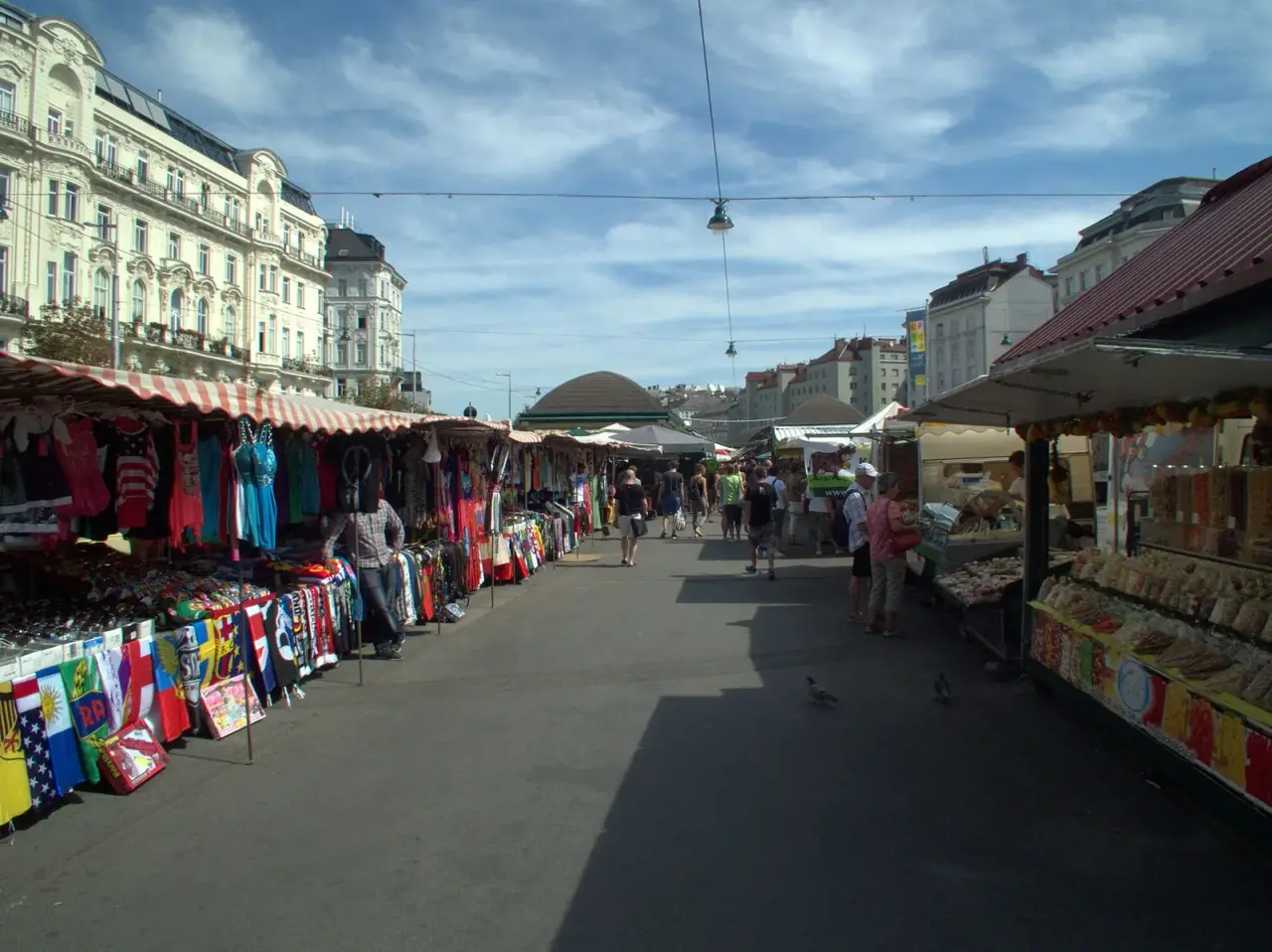
Recycling and the deposit return system (Pfand)
- PfandPfand
- A refundable deposit charged on top of the purchase price, returned when you bring the item back. Since 1 January 2025, Austria has charged a nationwide €0.25 per container deposit on single-use plastic and metal drinks containers — everything from water bottles to energy-drink cans — in sizes from 0.1 to 3 litres. What decides whether a container carries the deposit is the packaging material, not the drink: milk and milk-based drinks are carved out whatever they come in.
The deposit is collected at the till and refunded when you return the empty container, either to a reverse-vending machine at the entrance of most supermarkets or over the counter in smaller shops during normal opening hours. Keep containers uncrushed with the label and barcode readable — that is how the machines identify them. One limit is worth knowing before you arrive with a full bag: a shop without a machine only has to take back containers matching the material and size it sells itself, and only in the quantity a customer would normally buy there, so a small corner shop can decline a month's collection. Beverage cartons, milk cartons and glass bottles are outside this system — glass goes to a public recycling container, and reusable (Mehrweg) glass bottles carry their own separate deposit that predates the scheme. The full recycling and Pfand guide covers both systems and the return process step by step.
Pfand is only the most visible part of a much stricter household recycling culture than many students are used to. Flats and shared houses typically sort rubbish into several separate bins or bags: general waste (Restmüll), paper and cardboard, packaging (plastic, metal and composite — the yellow bin or bag), biological waste where collected, and glass at a nearby public container. Getting it wrong is not merely frowned upon: a bin contaminated with the wrong material can be refused collection, which in a shared building means a service charge passed on to everyone, not just the person responsible. Your building's Hausordnung (see below) or your landlord will usually explain the local set-up; when in doubt, Vienna's and other cities' municipal waste authorities publish exact sorting guides.
German in daily life
The short version, covered at length in the main guide and in the dedicated German-language guide: German is the predominant language of both instruction and daily life in Austria. Even on an English-taught programme, the university lecture hall is often the only place English reliably works. Outside it — the supermarket till, the pharmacy, the landlord, the doctor's receptionist, the immigration office, most part-time jobs — daily life runs in German, and getting comfortable with at least survival-level German early makes every other topic on this page easier. This page assumes you are building that German rather than avoiding it, and does not repeat the case for it here.
Social norms that catch people out
Austrian social conduct is more formal and more rule-bound than many international students expect, particularly students from cultures where warmth is expressed through informality. None of it is hostile — it is simply a different default, and getting the default right matters more here than in more relaxed cultures. Everything in this section is convention rather than regulation: no Austrian authority publishes an official etiquette standard, so treat these as what people reliably do, not as rules you can be penalised for breaking.
- Sie / duSie / du
- German has two forms of "you": the formal Sie, used by default with anyone you do not know personally — lecturers, landlords, shopkeepers, officials, older neighbours — and the informal du, used with friends, fellow students and children. Switching from Sie to du is normally offered by the older or more senior person, not initiated by you; staying with Sie until invited is always the safe choice.
Punctuality is taken literally rather than as a rough guideline: arriving even five minutes late to a university appointment, an office hour or a job interview reads as unreliable, not relaxed. Greetings follow a recognisable script — a handshake with "Grüß Gott" or the more casual "Servus" in person, first names only once you are on du terms — and a little small talk before getting to business is normal rather than a delay. Queueing is taken seriously: pushing in, at a bakery counter or a tram stop, draws visible disapproval. These are observed habits rather than codified ones, and they vary by region and generation; younger and more international circles in Vienna are noticeably more relaxed about all of them than a village in Tyrol.
- RuhezeitRuhezeit
- Quiet hours. Contrary to near-universal belief, there is no statutory Ruhezeit in Austria — the federal government's own guidance says so explicitly, and specifically denies that an absolute night rest runs from 22:00 to 06:00. Two separate things bind you instead. Your lease and your building's Hausordnung set contractual quiet hours: Vienna's municipal landlord uses 22:00–06:00 every day of the week, and private landlords commonly copy something close to it. Separately, noise is a matter for the nine Länder rather than the federal government, and they each make "improperly disturbing noise" (ungebührlicherweise störender Lärm) an administrative offence under their own security or police act — in Vienna punishable by up to €700, with police empowered to confiscate or switch off whatever is making the noise. That offence applies at any hour, which is the part people get wrong in both directions: a gathering at 23:00 may be perfectly lawful, and a drill at 15:00 may not be. Whether noise is "improper" is judged case by case, with night-time and Sundays weighing against you. If you are the one being kept awake, your practical routes are the Hausordnung — raise it with the landlord or building management — and, for persistent disturbance, the police under that Land offence; the civil claim for excessive noise from neighbouring land belongs to the property owner rather than to a tenant directly.
- HausordnungHausordnung
- The house rules attached to almost every rental building: quiet hours, rubbish sorting, use of shared areas like stairwells, laundry rooms and balconies, and sometimes snow-clearing duties in winter. It is usually a condition of the lease, not a polite suggestion, and repeated breaches are grounds a landlord can use against you. Because the law fixes no quiet hours of its own, this document is where yours actually come from — read it before you sign.
- TrinkgeldTrinkgeld
- Tipping. Voluntary, unregulated and not itemised on the bill: no Austrian body sets or publishes a rate, and nothing is added automatically. The settled convention in restaurants, cafés and taxis is to round up — commonly by something in the region of 5 to 10 per cent — and to state the total you want to pay as you hand over the money or card, rather than adding a separate line or leaving coins on the table.
The full social norms guide goes through greetings, invitations, dress and workplace conduct in more detail than fits here.
Discrimination: what to know and where to go
Austria is not free of racism or discrimination, and it would be dishonest to present it that way. The federal Equal Treatment Ombud handled 9,268 inquiries in its 2024/25 reporting period — the most in its history, and almost a third more than two years earlier. Of the discrimination cases it actively supported, gender was the largest ground and ethnic origin the second at 33%, the two together accounting for nearly four in five. Just as relevant for an international student: 25% of cases concerned access to goods and services rather than the workplace, and the Ombud names racism in access to housing and refusal of entry to bars and clubs as the two commonest themes in that group. In other words, the landlord who stops replying once they hear an accent and the bouncer who finds a reason not to let you in are not anecdotes — they are the single most documented pattern in the official record. It is not universal, and it is not something you have no recourse against.
What matters most in practice is knowing where to take it. The Gleichbehandlungsanwaltschaft (federal Equal Treatment Ombud) gives free, confidential advice on discrimination in employment, housing and access to goods and services, and can represent you before the Equal Treatment Commission; reach it on 0800 206 119, Monday to Thursday 09:00–15:00 and Friday mornings, with five regional offices between them covering all nine Länder. The Federal Chancellery runs a separate hotline for discrimination based on ethnic origin, descent or religion on 0800 222 666, Monday to Friday 08:00–16:00, which refers callers to the right specialist service rather than handling cases directly. ZARA (Zivilcourage und Anti-Rassismus-Arbeit) is a dedicated counselling service for people who have experienced or witnessed racism, offering documentation, accompaniment to authorities and help getting racist content removed, in person or anonymously online; it is one of the organisations the Ombud works with directly, including on joint guidance for bar and club operators. Most universities also run their own Ombudsstelle für Studierende (student ombuds office) and the student union (ÖH) maintains subject-specific referats that take discrimination and harassment reports on campus — start with your own university's student services if the incident happened there. None of these services require you to already have a lawyer or to be certain the incident meets a legal threshold; reporting, even just to get advice, is the point.
LGBTQ+ students face a more specific set of considerations, covered separately in the LGBTQ+ students guide; the support channels above generally apply there too, alongside services aimed specifically at that community. A fuller treatment of discrimination, including how to document an incident and what legal routes exist, is in the dedicated guide.
Safety, emergency numbers and realistic risk
Austria is consistently ranked among the safest countries in the world — 6 of 163 countries in the 2026 Global Peace Index, which is a composite measure of conflict, militarisation and societal safety rather than a crime rate. What the Austrian police actually put their prevention effort into is property crime, and their own guidance describes situations rather than landmarks: markets of every kind, public transport and its stops and railway stations, festivals and other large crowded events, and bars and clubs. The standard warning is about distraction — a stranger opening with a request for the time, directions or change while someone else works your bag. Carry bags and rucksacks closed and in front of you, split cash and cards rather than keeping everything in one pocket, and do not leave a phone on a café table. Bicycles, e-bikes and e-scooters are the other routine target, taken because they are badly locked and hard to prove ownership of: use a heavy key lock rather than a combination one, note the frame number, and pick up a Fahrradpass from a police station. Treat Austria's reputation for safety as a reason to be sensibly relaxed, not a reason to stop taking normal precautions.
| Number | For |
|---|---|
| 112 | Single European emergency number — any emergency, and callable from a locked phone without entering the PIN |
| 133 | Police (Polizei) |
| 122 | Fire brigade (Feuerwehr) |
| 144 | Ambulance (Rettung) |
| 116 006 | Helpline for victims of crime — support and referral after the event, not an emergency line |
To report a crime that has already happened, go in person to any Polizeiinspektion (police station) — every station takes the report, so you do not need to track down the "right" one. Theft is currently the only offence you can report online. Bring an official photo ID and anything that documents the incident: your own notes, screenshots either printed or on a USB stick, and the device itself if the offence happened on it. The dedicated safety guide covers reporting, helplines, and campus and night-life safety in more detail. For medical emergencies and how Austria's health system works day to day, see the healthcare guide.
Halal, ethnic groceries and second-hand shopping
Vienna, Graz, Linz and Austria's other larger cities all have an established halal and international grocery scene — Turkish, Middle Eastern, South Asian and East Asian shops and butchers concentrated in particular neighbourhoods rather than spread evenly, alongside halal-certified sections appearing in some mainstream supermarkets. The dedicated guide maps out where to find them city by city.
Second-hand culture is a genuine, underused money-saver for students furnishing a room or a flat from nothing. Caritas runs second-hand shops nationwide under the Carla brand, selling donated clothing, furniture, books and household goods cheaply, with proceeds funding Caritas's own aid work; university noticeboards, city flea markets and online marketplaces move furniture, bikes and second-hand textbooks between one graduating cohort and the next intake, often at the end of each semester when outgoing students sell up before leaving. The second-hand guide covers the specific platforms, flea markets and timing that make this work.
In practice: everyday how-to at a glance
| Task | What to know | Full steps |
|---|---|---|
| Return a bottle or can | Look for the deposit symbol, keep the container uncrushed, feed it into the machine at the supermarket and take the printed Pfandbon to the checkout of the same branch; the deposit is €0.25 per container | Recycling and Pfand |
| Throw away glass in Vienna | Clear glass in the white-lid container, coloured in the green-lid one, jars empty with the metal lid off; MA 48 asks for use only within 06:00–22:00 | Recycling and Pfand |
| Get rid of a mattress or sofa in Vienna | A Mistplatz is open Monday to Saturday, 07:00–18:00, for people registered in Vienna, in general up to 1 m³ per delivery | Recycling and Pfand |
| Buy food on a Sunday | Only narrow exceptions such as station and airport shops within their limits, petrol stations and hospitality; Vienna's ordinance adds a few listed items | Sunday closures |
| Shop at the till | No plastic carrier bags since 1 January 2020, so bring a bag; some stores have self-checkouts | Supermarkets |
| Use the laundry room (Vienna municipal housing) | Monday to Saturday, 06:00–20:00; closed on Sundays and public holidays; book your half day first | Cultural norms |
| Report a theft | Any police station takes the report for free; a written confirmation costs €21 on request unless it goes to an insurer or authority | Safety |
| Report discrimination | Call 0800 206 119 (Monday to Thursday 09:00–15:00, Friday 09:00–12:00) or use the online form in German or English | Discrimination |
How daily life connects to the rest of your move
Daily life does not start on its own — it follows directly from the practical steps in the arrival guide (registering your address, opening a bank account, getting your residence permit sorted) and depends on getting around, especially once you have picked which of Austria's student cities you are actually living in; daily life in Vienna, with its size and transport network, looks different from daily life in a smaller university town. Many of the habits above also intersect with part-time work — punctuality and formality apply doubly once you have an employer — and with staying healthy once you are settled in.
Frequently asked questions
Is living in Austria expensive?
For a student budget the biggest item is rent. According to the official 2025 student survey, students in Austria spend an average of €1,294 per month; the OeAD suggests about €1,300 per month and says Vienna and the other large cities cost more. Rules such as Sunday closing or the Pfand deposit change habits rather than costs. The full breakdown is on the cost of living in Austria.
Are supermarkets really closed all day on Sunday in Austria?
Yes, with narrow exceptions. Standard retail stays shut from Saturday 18:00 until Monday 06:00 under the Öffnungszeitengesetz 2003. Two different things open anyway: businesses the Act does not cover at all — petrol stations, limited to a fixed product range on a small floor area, and bakeries or confectioners that also hold a hospitality licence and offer seating — and a short list of exceptions inside the Act, mainly shops within stations and airports, plus venues selling refreshments to their own visitors. Plan your main grocery shop for Friday or Saturday morning.
Can I buy bread on a Sunday morning in Austria?
Often yes. A bakery that also holds a hospitality licence and puts out seating falls outside the opening-hours law and may sell its own bread and pastries on a Sunday, including to take away, as long as the business stays recognisably a bakery. Confectioners have a similar right. What you cannot do is a full grocery shop — a petrol station carries only pre-packaged food, soft drinks and travel goods in small quantities.
How does the bottle and can deposit (Pfand) work in Austria?
Since 1 January 2025, a 25-cent deposit is added at the till to single-use plastic and metal drinks containers between 0.1 and 3 litres. You get it back by returning the empty container, uncrushed and with the label readable, to a reverse-vending machine at most supermarkets or over the counter at smaller shops. A shop without a machine only has to accept containers of the material and size it sells itself, and only in normal household quantities. Beverage cartons, milk drinks and glass bottles are not part of this system.
Can I get by in English in daily life if my degree is taught in English?
Inside the university, usually yes. Outside it — shops, landlords, doctors, public offices, most part-time jobs — daily life in Austria runs predominantly in German, and an English-taught programme does not change that. Building at least survival-level German from early on makes everything else in this guide easier.
What do I do if I experience discrimination in Austria?
Contact the Gleichbehandlungsanwaltschaft (federal Equal Treatment Ombud) for free, confidential advice, or the Federal Chancellery's dedicated hotline if the incident involved ethnic origin, descent or religion. Be aware that protection differs by ground: ethnic origin is covered in housing and services as well as at work, while religion, age and sexual orientation are protected only in employment, so get advice before assuming you have or do not have a claim. ZARA offers specialist counselling for racism, and most universities run a student ombuds office for campus incidents.
Is Austria safe for international students?
By international comparison, yes: Austria ranks sixth of 163 countries in the 2026 Global Peace Index. The risks police actually warn about are property crime — pickpocketing in crowded places such as markets, public transport, stations and busy events, and theft of bicycles and e-scooters — rather than violence. Ordinary precautions, a decent bike lock and keeping bags closed and in front of you cover most of it.
Are there legally fixed quiet hours in Austria?
No. Contrary to widespread belief, Austrian law sets no statutory quiet period and no absolute night rest from 22:00 to 06:00. The hours that bind you come from your lease and your building's Hausordnung — 22:00 to 06:00 is a common house rule rather than a law. Separately, each Land makes improperly disturbing noise an administrative offence at any hour, finable in Vienna up to 700 euros, judged case by case.
Sources
22 sources, 19 official
- Pfandverordnung für Einweggetränkeverpackungen (BGBl. II Nr. 283/2023) — Gesamte RechtsvorschriftRIS (Rechtsinformationssystem des Bundes) (Official)
- Seit Jänner 2025: Neues Pfandsystem in Österreichoesterreich.gv.at (Federal Chancellery) (Official)
- Einwegpfand ab 2025WKO (Austrian Federal Economic Chamber) (Official)
- Öffnungszeitengesetz 2003 — Gesamte RechtsvorschriftRIS (Rechtsinformationssystem des Bundes) (Official)
- Gewerbeordnung 1994 § 157 (Tankstellen)RIS (Rechtsinformationssystem des Bundes) (Official)
- Gewerbeordnung 1994 § 111 (Gastgewerbe)RIS (Rechtsinformationssystem des Bundes) (Official)
- Das Mist-ABC — Müll richtig trennen und entsorgenStadt Wien (MA 48) (Official)
- Lärm (Störungen durch Nachbarn)oesterreich.gv.at (Federal Chancellery) (Official)
- Wiener Landes-Sicherheitsgesetz (WLSG), Art. I § 1 — Anstandsverletzung und LärmerregungRIS (Rechtsinformationssystem des Bundes), Landesnormen Wien (Official)
- Allgemeines bürgerliches Gesetzbuch (ABGB) § 364RIS (Rechtsinformationssystem des Bundes) (Official)
- HausordnungWiener Wohnen (City of Vienna) (Official)
- Diskriminierung — was kann ich tun?Gleichbehandlungsanwaltschaft (Federal Equal Treatment Ombud) (Official)
- Kontakt — Beratung und Vorfall meldenGleichbehandlungsanwaltschaft (Federal Equal Treatment Ombud) (Official)
- Gleichbehandlungsbericht für die Privatwirtschaft 2024 und 2025, Teil II — Anwaltschaft für Gleichbehandlung (III-399 der Beilagen XXVIII. GP)Parlament der Republik Österreich / Gleichbehandlungsanwaltschaft (Official)
- Hotline gegen Diskriminierung und IntoleranzBundeskanzleramt Österreich (Official)
- ZARA — Zivilcourage und Anti-Rassismus-Arbeit, BeratungsstellenZARA (Institutional)
- Emergency numbersoesterreich.gv.at (Federal Chancellery) (Official)
- Wie erstatte ich AnzeigeBundeskriminalamt (Austrian Federal Criminal Police Office) (Official)
- Taschendiebstahl — PräventionBundeskriminalamt (Austrian Federal Criminal Police Office) (Official)
- Fahrraddiebstahl — PräventionBundeskriminalamt (Austrian Federal Criminal Police Office) (Official)
- Why Iceland Stretched Its Lead Among the World's 10 Most Peaceful Countries in 2026Institute for Economics & Peace (Vision of Humanity, Global Peace Index) (Institutional)
- Carla Second Hand ShopCaritas Salzburg (Institutional)