If you are on an English-taught programme the honest answer is: inside the university you can usually manage in English, and outside it you usually cannot. OeAD is direct that German is the predominant language at Austria's universities and universities of applied sciences, and its listing counts around 600 programmes against the over 2,500 degree programmes it says the official studienwahl.at database holds — a real choice, but a minority. Daily life sits even more firmly in German: the supermarket till, the landlord, the doctor's receptionist, the immigration office and many part-time jobs run in German no matter which language you study in. None of this has to be a barrier. You do not need German to get your student residence permit, and a little survival German goes a long way. This page is about what you need to live here, not to be admitted — for that, see German and English language requirements.
The short answer
Two different questions get conflated. Do you need German to be admitted? Only if your programme is German-taught — and even then a public university can let you apply with A2 and finish German in a preparatory course before regular admission. That is the admissions question, not this page. Do you need German to live here once you have arrived? Yes, progressively — but you can start with almost none and build it as you go. There is no German requirement attached to your residence permit, and most of daily life is navigable with A1/A2 survival German. The real threshold is B1/B2, the point at which independent living — a German-language job, a full conversation with a doctor, a rental contract you can read yourself — becomes realistic.
Where English works — and where it stops
The clearest way to think about it is that English covers the small, enclosed world of your programme and German covers everything else. The lecture hall, the library and the international office are the places an English-taught student can genuinely function in English; the rest of the week is spent in German. The table below is a practical map, not a legal one — none of these thresholds are formal requirements, they are simply where the language barrier becomes real.
| Situation | What to expect, and the German that helps |
|---|---|
| On campus, on an English-taught programme | English works. Administrative offices usually have at least one English-capable contact. |
| Supermarket, shops, public transport | Almost no speaking needed — self-service, prices on screens and card payment carry you through from day one. |
| Doctor, pharmacy, hospital | You must describe symptoms. English is common in Vienna and larger cities but not guaranteed; A2/B1 makes this safe. |
| Renting, landlords, contracts | Written German. Get a German-speaking friend or your student union (ÖH) to read anything before you sign. |
| Public offices — address registration, permit renewal | Forms are in German and officials' English varies; the steps themselves are covered in the arrival guide. |
| Part-time jobs | Customer-facing work usually needs B1/B2. English-only student jobs exist but are a narrow slice; see working as a student. |
The CEFR levels, in plain terms
- CEFRGemeinsamer Europäischer Referenzrahmen (GER)
- The Common European Framework of Reference for Languages, the six-level scale (A1–C2) used across Europe to describe how well someone can use a language. Austrian universities, the ÖIF and the Volkshochschulen all set German requirements and course levels against it.
The level descriptions below are the framework's own; the practical notes are how they play out for a student's daily life. You do not need to aim at a certificate to use this — the levels are simply the clearest way to describe where you are.
- A1 — beginner. Introduce yourself, understand and use very simple everyday phrases, ask and answer simple questions. Enough to greet, order, pay and navigate a shop; not enough to explain a problem.
- A2 — basic. Handle routine situations — shopping, directions, a simple appointment — and describe yourself and your immediate surroundings in elementary terms. This is the level Austria's Integration Agreement calls 'Module 1', though students are not required to reach it (see below).
- B1 — independent. Cope with familiar everyday and travel situations, talk coherently about personal interests and briefly justify an opinion. The level at which daily life genuinely stops being a struggle and where a German-speaking workplace becomes conceivable.
- B2 — independent. Understand complex texts, argue a point, and converse spontaneously and fluently with native speakers. The level that removes German as a practical barrier to most student jobs and, later, the 'special integration' citizenship route.
- C1 — proficient. Express yourself clearly, in detail and flexibly on complex subjects. This is what the University of Vienna requires (C1) for regular admission to German-taught programmes.
- C2 — mastery. Near native-speaker command. Almost never needed, and not worth chasing as a student.
Learning German in Austria, cheaply or for free
The cheapest useful thing in Austrian language learning is genuinely free. The ÖIF's Sprachportal (sprachportal.at) is a large free platform — thousands of exercises, learning videos and podcasts, and daily live online courses at A1 to B2 led by instructors — and it is open to everyone, not only to people in the subsidised-course system. Its materials deliberately cover Austrian German and everyday life in Austria, which makes it a better starting point than a generic app.
- Volkshochschule (VHS)Volkshochschule (VHS)
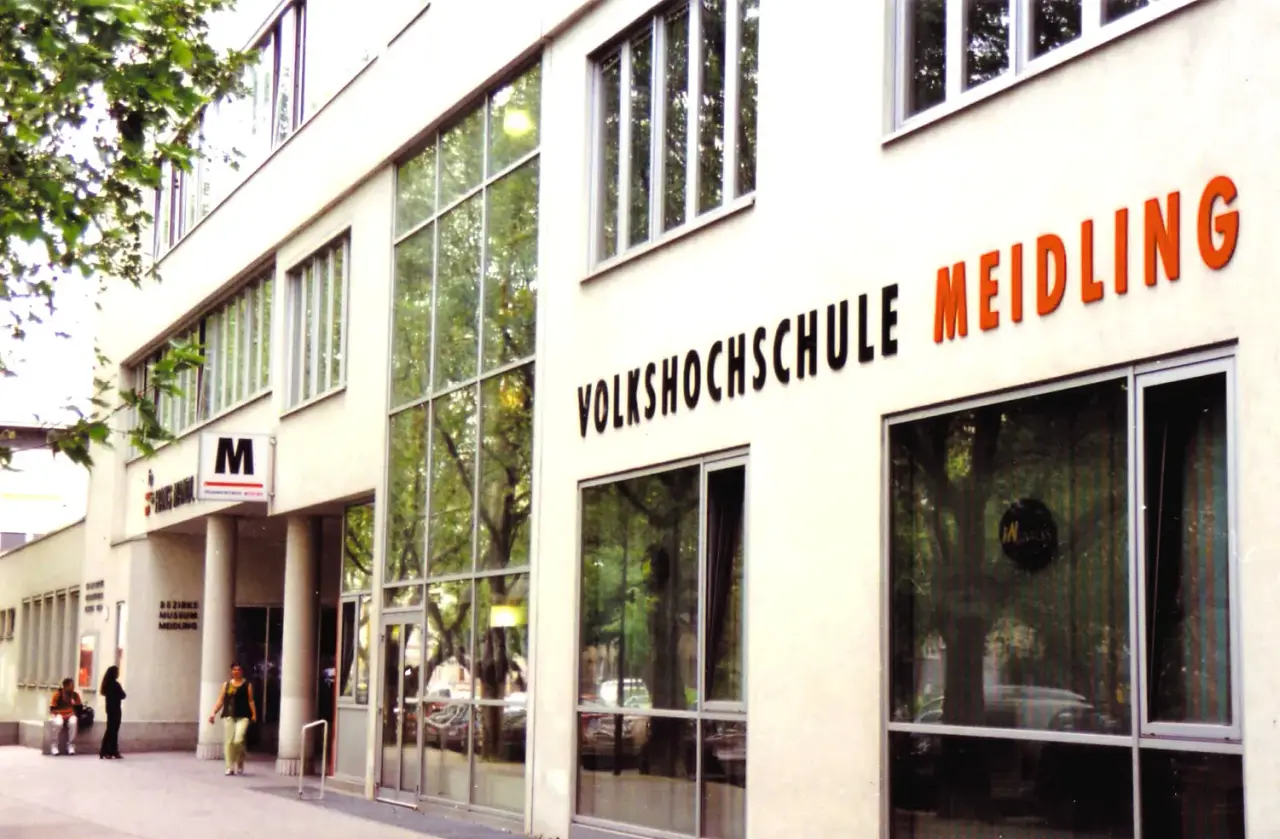
- Austria's publicly subsidised adult-education centres. They run by far the cheapest classroom German courses — in Vienna, a broad network of centres teaches German as a second language from A1 to C2, with free placement advice.
For a classroom course, the Volkshochschulen are the price benchmark. In Vienna a German course currently costs €470 for one part — and each CEFR level is taught in two parts (A1 then A1+, and so on), so a complete level is about twice that. Shorter single-skill 'focus' courses on speaking or grammar start from €116. University language centres are a step up in price: the University of Vienna's own Language Centre runs an intensive German semester course at €1,280 per semester, though it is a five-days-a-week format aimed as much at future applicants as at current students. If you are still before admission and need German to enter, the subsidised Vorstudienlehrgang (preparatory course) is the correct route rather than any of the above. Tandem exchanges — pairing up with someone learning your language — are organised by several universities' language centres and cost nothing.
In practice: enrolling in the University of Vienna's German course
The Language Centre's semester course is the one classroom option in this article whose page could be read directly, and that page spells out how enrolment works. The centre is at Alser Straße 4, Campus der Universität Wien, Hof 1, Zugang 1.16, 1090 Wien, and the course is open to anyone aged 16 or over.
Choose your entry route
With no German, register online for A1/1. With some German, register for a course with placement (MIT EINSTUFUNG): the test has a written and an oral part, and the details are sent after you book. If you hold an ÖSD or Goethe certificate under a year old that shows at least 80% in each of listening, reading, writing and speaking, email it to the centre to be placed in a higher phase.
Watch the dates
The page showed remaining places for the winter course (7 October 2026 to 22 January 2027) through the secretariat. Registration for the summer course (10 March to 18 June 2027) opens on 2 February 2027, and the timetable is published from then.
Pay and buy the book
The fee is €1,280 per semester, paid by bank transfer, and it does not include the textbook. The centre names the book after the placement test; it is sold by the facultas bookshop on Universitätsstraße or as an e-book, and handouts and exercises come through the centre's Moodle platform.
Finish for credit
At least 75% attendance over the course and a passed final exam earn a certificate worth 12 ECTS. Whether your own degree programme counts those credits is decided by its Studienprogrammleitung, so ask before you rely on them. With the attendance but no pass, you can ask for a participation confirmation.
German, your residence permit and your job
It is worth stating the permit point precisely, because it is where people either panic or stop preparing. Getting and renewing the student residence permit does not require any proof of German. The permit's conditions are about money, accommodation, insurance, a police clearance certificate and an admission letter — no language certificate, and no German level in the law itself. Austria does have an 'Integration Agreement' that requires A2 German for certain residence titles, but the ÖIF's own list of the permits that must complete it does not include the student permit. Where German does become a legal threshold is later and optional: naturalisation normally requires B1, and the faster six-year route B2 — covered in staying in Austria after graduation, not something you need to think about on day one.
Work is where the German question is most consequential while you study. The jobs a student can realistically take — supermarket shelves, cafés, shops, tutoring, hospitality — are mostly customer- or colleague-facing and run in German, so the practical constraint on working is your German more than the permit itself. No official body publishes a count of which student jobs require German, so treat that as a practical generalisation rather than a statistic. The permit side of it (your employer applies, and no labour-market test applies up to a weekly hour limit) is explained in the work guide, including where the English-speaking jobs are. Once you can hold a B1-level conversation, a genuinely wider range of work opens up.
Austrian German vs standard German (and dialect)
- HochdeutschHochdeutsch
- Standard German, the written and formal spoken register. This is what you learn in a course, what documents are written in, and what lecturers use. Regional dialects are a spoken layer on top of it, not a replacement.
Learners worry about dialect more than they need to. Written German in Austria is standard German; formal speech and teaching use standard German; and the German taught in every course is Hochdeutsch. What you will actually hear on the street, in markets and among friends includes regional colour — Austrian vocabulary, a softer southern pronunciation, and in the west genuine dialect — but people will almost always switch to clearer standard German for a learner who asks them to. The ÖIF's own materials treat this openly, teaching Austrian German as a topic and publishing listening exercises in dialect and colloquial versions precisely so learners get used to it. The one genuinely relevant social point is formality: German's Sie/du distinction matters in Austria, and getting it wrong reads badly in a way English cannot reproduce — the social norms guide explains it.
Frequently asked questions
Do I need German to live in Austria if my degree is taught in English?
Inside the university, usually not. Outside it — the supermarket till, the landlord, the doctor's receptionist, the immigration office and many part-time jobs — daily life in Austria runs in German, and an English-taught degree does not change that. You can start with almost no German and build it, because there is no German requirement on your residence permit, but plan to reach at least A2 quickly and B1/B2 if you want to work or live independently.
Do I need German for the Austrian student residence permit?
No. The student residence permit has no language requirement: its checklist covers funds, accommodation, insurance, a police clearance certificate and your admission letter, and there is no German level in the law itself. Austria's Integration Agreement, which requires A2 German, applies only to a listed set of residence titles that does not include the student permit. German only becomes a legal threshold much later, for citizenship.
What CEFR level of German do I need for daily life in Austria?
For surviving and handling routine situations — shopping, directions, a simple doctor's visit — A1 to A2 is enough. B1 is where daily life stops being a struggle and a German-speaking workplace becomes conceivable; B2 opens German-language jobs and later the faster citizenship route. Admission to a German-taught degree is a separate, higher bar, usually C1 at the University of Vienna.
Where can I learn German cheaply in Austria as a student?
The ÖIF's Sprachportal (sprachportal.at) is free and open to everyone, with thousands of exercises and daily live online courses at A1–B2. For classroom teaching, the Volkshochschulen are the cheapest — in Vienna a course part costs €470 (each level is two parts), with shorter focus courses from €116. The ÖIF's free classroom courses are not available to students: they are reserved for refugees, subsidiary-protection holders and displaced persons from Ukraine.
Is Austrian German different from standard German?
Written German and formal or teaching speech are standard German (Hochdeutsch) — that is what courses teach and documents use. Spoken everyday German adds Austrian vocabulary and a regional pronunciation, and the western Länder speak genuine dialect, but speakers will normally switch to clearer standard German for a learner. The ÖIF's learning materials cover Austrian German and include dialect versions of listening exercises on purpose.
Can I get a student job in Austria without German?
A narrow slice of student jobs runs in English — some tutoring, delivery work and roles at international companies — but customer- and colleague-facing work (retail, cafés, hospitality) usually needs German at roughly B1. The practical limit on most students' employment is their German rather than the permit, since the permit itself is available for part-time work without a labour-market test.
Sources
8 sources, all official
- Deutsch A1 (VHS Favoriten) — KursdetailsDie Wiener Volkshochschulen GmbH (City of Vienna) (Official)
- Deutschkurse (DAZ) — WienDie Wiener Volkshochschulen GmbH (City of Vienna) (Official)
- Semesterkurse für DeutschSprachenzentrum der Universität Wien (University of Vienna Language Centre) (Official)
- My Language Portal at a glanceÖsterreichischer Integrationsfonds (ÖIF) (Official)
- Deutschkurse in Österreich – Geförderte Kurse & AnmeldungÖsterreichischer Integrationsfonds (ÖIF) (Official)
- Niederlassungs- und Aufenthaltsgesetz § 64 (Studenten), Fassung vom 15.10.2026RIS – Rechtsinformationssystem des Bundes (Official)
- Learning GermanOeAD / Study in Austria (Official)
- Residence permit – student (no mobility programme)OeAD – Austria's Agency for Education and Internationalisation (Official)