These are the finance ministry's (BMF) rules for anyone entering Austria from outside the EU; the pages we read name no exception for Türkiye. Customs is done where you first enter the EU, so if you land in another member state first, that state's customs applies first. For what to pack, see the packing guide; the first-month sequence is in the first 30 days.
- AllowanceFreimenge / Freigrenze
- The quantity of tobacco, alcohol or medicine (Freimenge) or value of other goods (Freigrenze) you may bring in without paying import charges.
- Removal goodsÜbersiedlungsgut
- Used household goods brought along when you move your ordinary residence to an EU state, which can enter free of customs duty and import VAT if the conditions are met.
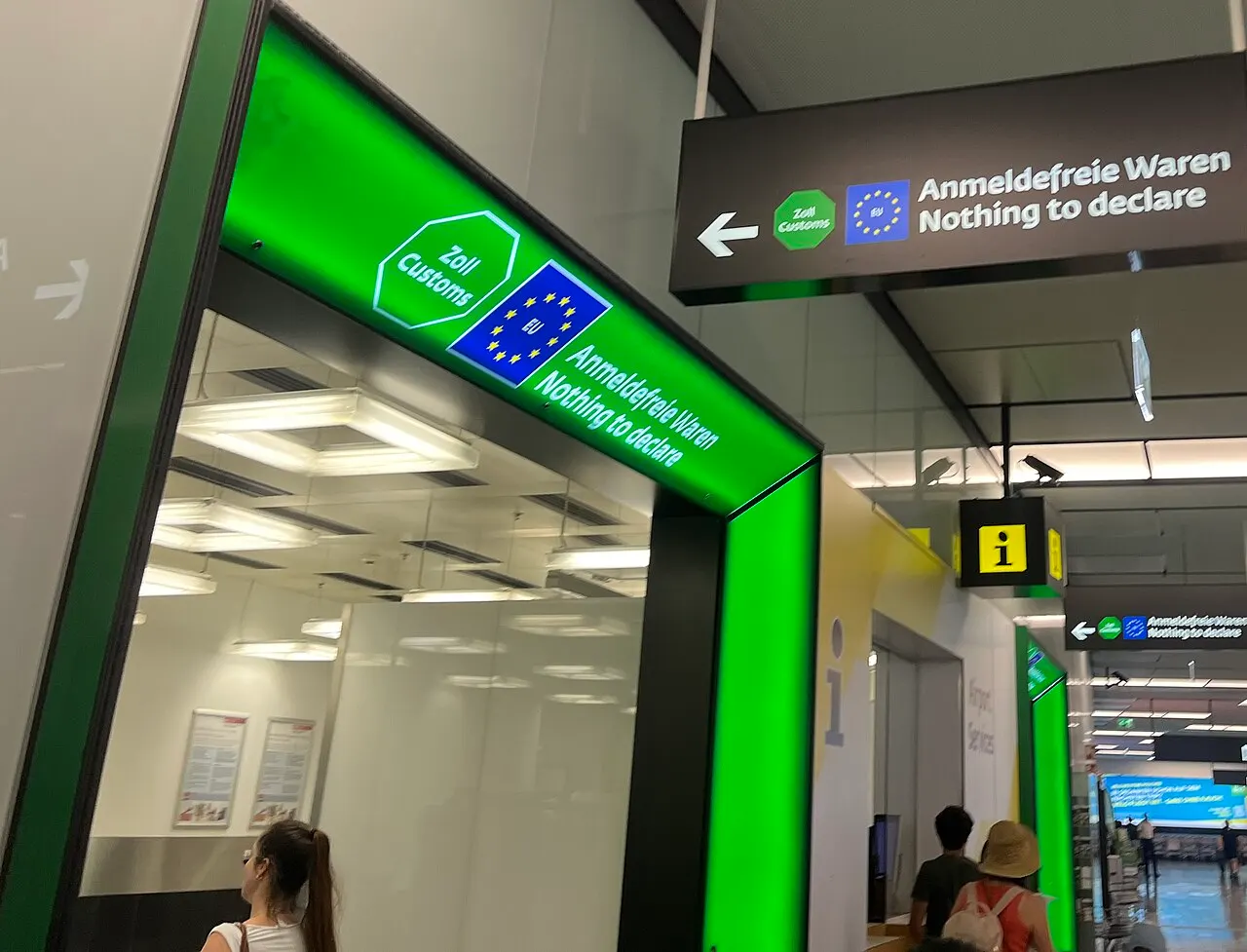
- Red and green channelRotkanal / Grünkanal
- Where a customs point has two exits, red is for travellers with goods to declare and green for those with none. With one exit, you declare of your own accord.
Duty-free allowances for your luggage
| Goods | Allowance per traveller | Notes |
|---|---|---|
| Tobacco, aged 17 years or older | 200 cigarettes, or 100 cigarillos, or 50 cigars, or 250 grams of smoking tobacco | A proportional mix is allowed; heated-tobacco sticks fall under the value limit below |
| Spirits, aged 17 years or older | 1 litre of spirits above 22 % vol., or 2 litres of alcohol up to 22 % vol. | A proportional mix of the two is allowed |
| Still wine and beer | In addition, 4 litres of still wine and 16 litres of beer | Same age limit; counted by quantity, not against the value limit |
| Other goods (clothes, electronics, gifts) | €300 by land or sea, €430 by air; €150 for children under 15 | Non-commercial imports only |
| Medicines | The quantity your travel needs, and up to 3 retail packs if acquired abroad | See the medicines section |
Above the allowance you must declare the goods and pay. The BMF clears up to €700 of goods above the allowances at a flat 2.5% customs rate, which excludes tobacco, and you can ask for the EU tariff rates instead before clearance starts; the page describes the customs duty only, not import VAT, so ask the customs office what else is due. The charge is calculated on the purchase price, so keep receipts: without proof, customs uses comparable prices or estimates the value. Goods under import bans or restrictions have to be declared even when they are inside the allowance.
Moving your belongings: Übersiedlungsgut and the student question
Goods brought along on a move of residence are treated more generously than luggage, but only if the move is real in the customs sense. The BMF defines ordinary residence as the place where, because of personal ties, you live at least 185 days in a calendar year, and states that attending a university or school does not lead to a transfer of residence: you can keep your foreign residence as a secondary one. For a degree student whose life stays centred at home, the removal relief is therefore normally not the tool. The page does not say how a student whose ties have in fact moved to Austria is treated; ask the customs office.
| Condition | Requirement |
|---|---|
| The goods | Your own used goods, not new; alcohol, tobacco, commercial vehicles and goods used commercially are excluded |
| Where you move | Your ordinary residence moves to an EU state |
| Use before the move | Used at your former residence for at least 6 months before you gave it up, and for the same purposes in the EU |
| Residence abroad | You had your ordinary residence abroad for at least 12 months in a row |
| Timing | You declare the goods within 12 months of establishing residence in Austria |
| Afterwards | No selling or passing on for 12 months after clearance without telling customs and paying the charges |
If the conditions are met, you declare the goods with form ZBefr 2 at clearance. You apply in advance for a base decision on form ZBefr 2a if a vehicle is included, if you will keep a residence outside the EU (unless you have two only because you registered at the new one in advance), or if the goods arrive before you have established residence; with no Austrian residence yet, any customs office is competent. Missing papers do not block clearance: you pay or give security and are refunded once you supply them. Proof can be a foreign deregistration confirmation, an Austrian registration confirmation, an employment or rental contract.
Medicines
Three official pages speak to medicines, and none says which wording governs a student arriving to live here for years. The BMF allowance page allows the quantity your travel needs, and limits medicine acquired abroad to 3 retail packs per person without an import authorisation. The BMF medicines page adds that private persons in principle may not carry medicines under the Arzneiwareneinfuhrgesetz, with exceptions for Austrian residents and for residents abroad carrying what they need during the trip. The Sozialministerium describes the usual personal need as no more than 3 packs of the smallest pack size.
- Treat three packs of each medicine as the working limit, and declare in the red channel if you carry more.
- Carry proof of need: a doctor's confirmation with your details, the need to continue treatment and the generic name and dosage, with the medicine in original packaging; a certified translation is recommended if it is not in German.
- Narcotic or psychotropic substances follow stricter rules: stays up to 5 days need no further confirmation, stays beyond that up to 30 days need a prescription from your home doctor and no more than 30 days of supply, and longer stays call for a prescription from a doctor in Austria.
- Supplements can count as medicines: the BMF includes herbal, homeopathic and vitamin or mineral preparations used to treat or prevent specific conditions, which it says are often sold as food supplements with at least three times the usual daily dose.
For a stay of years the practical answer is a bridge: bring a first supply with the letter, then see an Austrian doctor (finding a doctor) and get the continuing prescription there.
Food, plants and animal products
| Product | In personal luggage |
|---|---|
| Meat and meat products, milk and milk products | None: the quantity is 0 |
| Fish and fishery products | One fish or 20 kg, whichever is more, gutted if fresh |
| Honey, beeswax, royal jelly, propolis, pollen; consumer eggs | 2 kg of each category |
| Infant milk powder, infant formula, medical foods | 2 kg: packaged branded products that need no refrigeration, unopened |
| Shelf-stable sweets, chocolate, pasta, bread, biscuits, coffee and tea extracts, liqueur and similar | No quantity limit, if they contain no meat, raw fish, or milk or milk products |
| Fruit, vegetables, flowers, seeds, plants | Certain ones need a plant health certificate and an official check; bananas, dates, pineapples, durians and coconuts do not |
The animal-product limits come from a BMF country list dated 27 June 2022, still the file linked from its live page. Türkiye does not appear in it, so the row for countries not listed applies. The BMF also warns against bringing meat products, especially pork and wild boar products from private production, because of African swine fever. Goods needing a plant health certificate may enter only through the airports of Vienna, Graz and Linz and must be declared in the red channel. Its other restricted categories include protected species, cultural property, weapons, pirated goods and fireworks. Check each food item's ingredients against the table.
Cash
Anyone entering or leaving the EU with €10,000 or more in cash must declare it to customs, each person in a group separately and parents for minors. The BMF counts more than banknotes: cheques and traveller's cheques, gold coins of at least 90 % gold content and gold bars of at least 99.5 % all count, and customs may act below the threshold if there are signs of criminal activity. Within the EU the threshold is declared only on request. For tuition, rent and deposits a bank transfer is usually simpler; see international transfers.
In practice: at the customs point in Vienna
Vienna Airport's own customs page puts the customs office (Zollbüro) in the arrival hall on level 0, and says the declaration forms for cash of €10,000 or more are available at the customs counters or at the Zollamt. The page is the airport operator's, not the customs authority's, and its allowances match the BMF figures above; it spells the cigarette limit out as "200 pieces or 10 packs". Outside Vienna, ask at the customs point of the airport you land at.
Collect your bags, then choose the exit
Where a customs point has two exits, the red one is for travellers with goods to declare and the green one for those with none; with a single exit you declare of your own accord. The BMF advises declaring everything in case of doubt, and says duty exemptions are applied in any case.
Declare cash at or above the threshold
From €10,000 per person, use the form on the Austrian customs website, or the one available at the customs counters at the airport.
Have the medicines paperwork in your hand luggage
A prescription or a doctor's letter, as the medicines section explains, belongs in the cabin bag rather than the suitcase.
Keep the receipts for what you bought outside the EU
The BMF calculates the charge on the purchase price, so a receipt is what lets you show what an item cost.
If something may not enter, ask before you leave the hall
The airport's page lists a fee if you have to leave goods with customs: €7 per day and item, or €12 per day for a large item.
Frequently asked questions
How much can I bring into Austria duty-free from Türkiye?
Goods for your own use or as gifts are duty-free up to €300 by land or sea and €430 by air, or €150 for children under 15. Tobacco and alcohol have separate quantity allowances for travellers aged 17 years or older, and the BMF pages we read name no exception for Türkiye.
Can I bring a laptop and electronics I already own?
Items for your own use are within the duty-free rules, and a new purchase counts against the value allowance, so keep the receipt. For a traveller whose residence is outside the EU the BMF allows equipment serving the journey to be used duty-free for the stay, without passing it on, and says customs may ask for a declaration of very valuable items such as computers. It does not say how a long-owned laptop is treated for a multi-year stay, so carry proof of ownership and, if in doubt, declare it.
Can I bring meat, cheese or milk products from home?
No. For travellers from countries not individually listed by the BMF, which includes Türkiye, the personal-luggage quantity for meat products, milk and milk products is 0. Shelf-stable sweets, chocolate, pasta, bread and biscuits are exempt from limits if they contain no meat, raw fish or milk products. Infant milk powder is allowed up to 2 kg if packaged and unopened.
Can I bring my prescription medicine?
Yes, with limits and proof. The Sozialministerium describes the usual personal need as up to 3 packs of the smallest pack size and asks for a doctor's confirmation for prescription medicines. Narcotic or psychotropic medicines have separate rules by length of stay. No page says which wording applies to a student moving for years, so carry a doctor's letter and declare larger quantities.
Do I have to declare cash when I arrive in Austria?
Yes, if you carry €10,000 or more in cash when entering the EU from a country outside it. The duty applies per person and covers cheques, traveller's cheques and gold above set purity. Within the EU you declare it only if customs asks.
Can I use the moving-house relief as a student?
Probably not on the strength of a degree alone. The BMF says attending a university or school does not transfer your ordinary residence, and the relief needs used goods, 12 months of residence abroad and a declaration within 12 months. If you believe your ties have really moved to Austria, ask the customs office before you ship anything.
Sources
14 sources, 13 official
- Freimengen und Freigrenze (Einreise aus Nicht-EU-Staaten)Bundesministerium für Finanzen (BMF) — Zoll (Official)
- Welche Waren müssen beim Zoll deklariert werden?Bundesministerium für Finanzen (Zoll) (Official)
- EingangsabgabenBundesministerium für Finanzen (Zoll) (Official)
- Verzollung zum PauschalsatzBundesministerium für Finanzen (Zoll) (Official)
- Übersiedlung aus einem Nicht-EU-StaatBundesministerium für Finanzen (Zoll) (Official)
- Begriffsbestimmungen ÜbersiedlungsgutBundesministerium für Finanzen (Zoll) (Official)
- Arzneimittel (Einfuhrverbote und Einfuhrbeschränkungen im Reiseverkehr)Bundesministerium für Finanzen (Zoll) (Official)
- Mitnahme von suchtmittelhaltigen Arzneimitteln nach ÖsterreichSozialministerium (BMASGPK) (Official)
- Fleisch und Fleischerzeugnisse, Milch und Milcherzeugnisse sowie andere tierische ErzeugnisseBundesministerium für Finanzen (Zoll) (Official)
- Veterinärbestimmungen für Waren tierischen Ursprungs für den persönlichen Verbrauch (country list, Stand 27 June 2022)Bundesministerium für Finanzen (Zoll) (Official)
- Pflanzen, Pflanzenteile, Obst, Gemüse, Blumen und SaatgutBundesministerium für Finanzen (Zoll) (Official)
- Mitnahme von BargeldBundesministerium für Finanzen (BMF) — Zoll (Official)
- Mitnahme von Bargeld bei Reisen innerhalb der EUoesterreich.gv.at (Official)
- Zoll — Flughafen Wien (Zollkontrolle, Einfuhrbestimmungen, Zollhinterlegung)Flughafen Wien AG (Institutional)