Austria trains doctors at three medical universities (Vienna, Innsbruck and Graz) and at the Faculty of Medicine of Johannes Kepler University (JKU) Linz. All four admit first-year students only through one joint entrance test, the MedAT, and all four teach in German. That combination decides almost everything for an international applicant: the test is in German, the places are capped, and in human medicine a quota limits how many places can go to applicants who are neither EU citizens nor holders of an Austrian school-leaving certificate. This page sets out the requirements, the quota, the costs and a realistic plan; the mechanics of the test day itself are covered in entrance exams at Austrian universities.
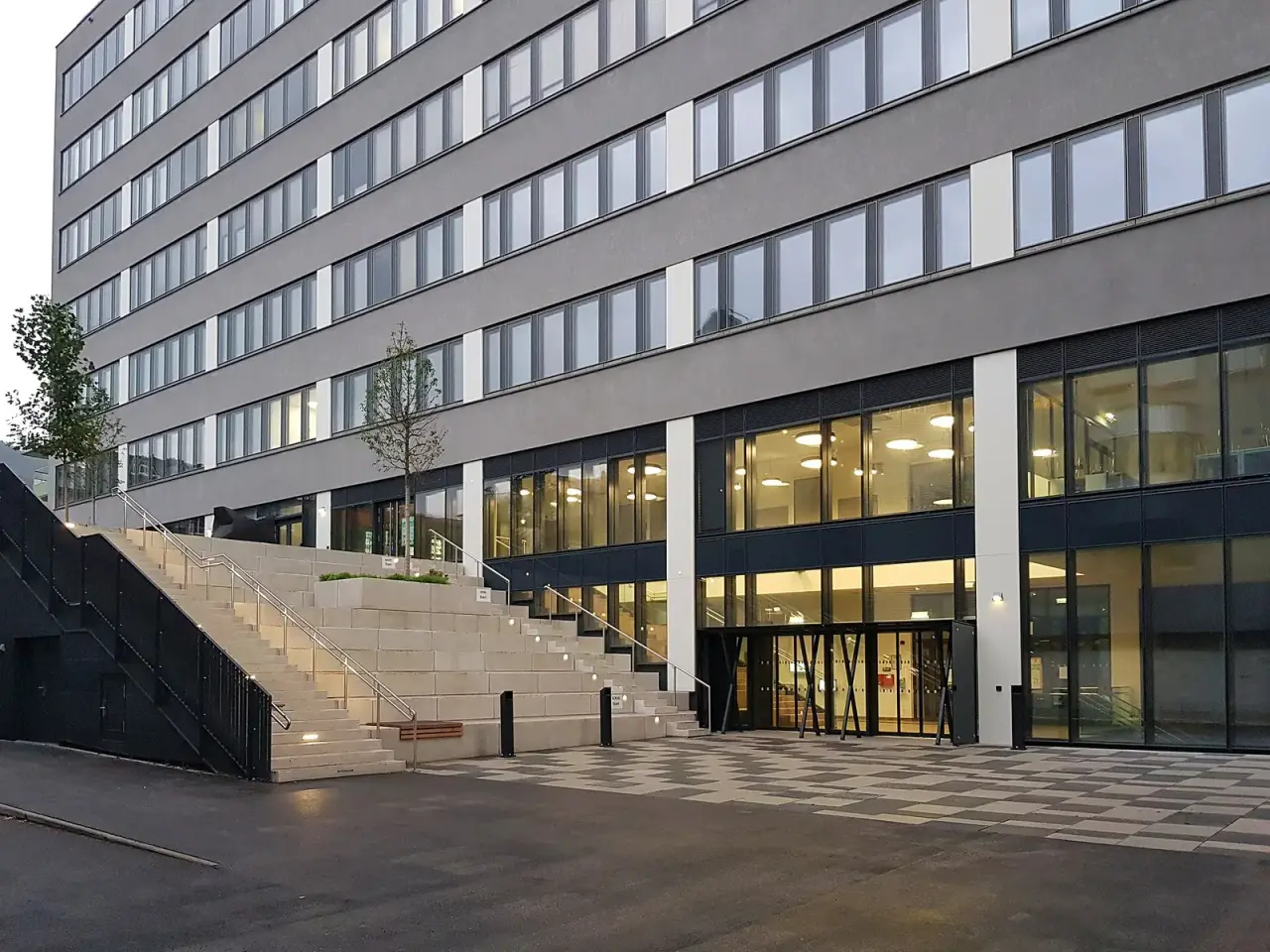
Where can you study medicine in Austria?
Human medicine (Humanmedizin) and dentistry (Zahnmedizin) at public universities are diploma programmes, a pre-Bologna format that leads straight to the doctor's title rather than to a bachelor's and a master's. At the Medical University of Vienna human medicine runs 12 semesters (360 ECTS) and ends with the degree Dr. med. univ. The table shows the places the MedAT allocated for 2026/27; the total was 1,950, of which 1,806 were in human medicine and 144 in dentistry.
| University | Human medicine | Dentistry |
|---|---|---|
| Medical University of Vienna | 704 | 80 |
| Medical University of Innsbruck | 390 | 40 |
| Medical University of Graz | 382 | 24 |
| JKU Linz, Faculty of Medicine | 330 | Not offered |
| Total | 1,806 | 144 |
- Diploma programmeDiplomstudium
- A single long degree programme without a bachelor's stage. In medicine it leads to the academic degree Doctor medicinae universae (Dr. med. univ.), which is a professional first degree, not a research doctorate.
Accredited private universities also train doctors outside the MedAT system, with their own selection and their own fees; they are covered further down. For the wider structure of Austrian degrees, see studying in Austria, and for ordinary bachelor's programmes that do not need the MedAT, bachelor's degrees in Austria.
What do you need to be admitted?
Admission happens in two stages. First you need a place through the MedAT; the medical universities check your documents only afterwards, at personal admission once the results are out. MedUni Vienna states that no school-leaving certificate is needed to register for or sit the test, as long as you are at least in your final (12th or 13th) school year. Then, to be admitted, you prove four things.
- The general university entrance qualification. A school-leaving certificate without substantial difference from the Austrian Matura, or a completed degree of at least three years. For a Turkish lise diploma this means the diploma together with a passed Turkish university entrance exam: see the YKS rule for Austrian universities.
- The special university entrance qualification. For medicine the University Entrance Qualification Decree (UBVO) names Latin and biology. Latin must be passed before the first diploma exam unless you had Latin at school for at least 10 weekly hours. The biology exam can be dropped where the admission test already covers it, and MedUni Vienna has dropped it for human medicine and dentistry.
- German at C1. The MedAT site states that both first admission and continuing medical studies require it. MedUni Vienna accepts, among others, DSH 2 or TestDaF with TDN 4 in every part, no older than three years; without such proof you take the German supplementary exam in a preparatory programme.
- Your MedAT place for the university and programme you registered for. A result counts only at the one location you chose.
- Supplementary examErgänzungsprüfung / Zusatzprüfung
- An exam the university prescribes when your school certificate lacks something the Austrian system expects, such as Latin for medicine or C1 German. Some must be passed before admission, others during the programme; the admission letter says which.
The MedAT in brief
The MedAT is held once a year on the same day at all four locations. The 2026 test took place on 3 July 2026 after registration from 2–31 March 2026, with a fee of €110. For 2027 the MedAT site expects registration from 1-31 March 2027 and the test on 9 July 2027; results follow from calendar week 32. Registration and payment are not possible after the deadline. You choose one location and one programme, and in human medicine you also choose your quota.
Human medicine uses the MedAT-H and dentistry the MedAT-Z. Both test basic science knowledge (biology, chemistry, physics and mathematics), cognitive skills and social-emotional competences; the human-medicine version adds reading comprehension and the dentistry version adds manual dexterity tasks. The test parts, the test-day rules at each venue and what to bring are set out in entrance exams and restricted-admission programmes.

The quota: what the 5 per cent means for Turkish applicants
Under § 71c(5) of the Universities Act, at least 95% of first-year places in human medicine are reserved for EU citizens and people with equivalent access to higher education, and at least 75% for holders of an Austrian school-leaving certificate. The MedAT site groups applicants into three quotas when they register: the Austrian quota (an Austrian Matura, whatever your citizenship), the EU quota (EU citizens and equivalents with a non-Austrian certificate) and the Non-EU quota (third-country nationals with a non-Austrian certificate). A Turkish citizen with a Turkish lise diploma registers in the Non-EU quota. If the Personengruppenverordnung covers you, the MedAT site says the Austrian quota applies instead.
The Non-EU quota can receive at most 5% of the human-medicine places. In 2026/27 that ceiling worked out at about 90 of 1,806 places across the four universities. The law then allows performance agreements to set aside places for tasks in the public interest from that same 5 per cent band (§ 71c(5a)); for 2026/27 the universities announced up to 87 such places, for which applicants commit to work for a federal state, the health insurance fund or a ministry and need a minimum score. Neither the universities nor the MedAT site publish how many places were left for Non-EU-quota applicants after that, so treat the realistic number as small and unknown.
| Human medicine | Dentistry | |
|---|---|---|
| Places 2026/27 | 1,806 | 144 |
| Quota | At most 5% for the Non-EU quota; public-interest places come from the same band | No quota: one ranking per location |
| Locations | Vienna, Innsbruck, Graz, Linz | Vienna, Innsbruck, Graz |
| Test version | MedAT-H | MedAT-Z (with manual dexterity tasks) |
Is studying medicine in Austria free?
Not for most third-country students. Public medical universities charge the same statutory tuition as other public universities: €726.72 per semester for third-country students on a student residence permit, plus the €26.20 ÖH student-union fee every student pays each semester. There is no extra charge for medicine. On top come the €110 MedAT fee each year you sit the test, German courses or a preparatory programme, and living costs, which in Austria are driven by rent; see Austrian university fees and the monthly cost of living. For the residence permit you also prove the statutory monthly means described in financial proof for the student permit.
Can you study medicine in Austria in English?
Not at the public medical universities: the MedAT site states that the test and its preparation materials are available in German only, and that admission and continuation both require German at C1. The private university read for this page, Paracelsus Medical Private University in Salzburg, also asks for excellent German and English (between B2 and C1). Programmes advertised as English-taught medicine in Austria should therefore be checked carefully against the institution's accreditation and language rules before you pay anything.
Private medical universities
Accredited private universities run their own admission procedures and set their own fees, which are far above the public tuition (PMU lists €22,300 per year for its bachelor's in human medicine); the general rules for private institutions are in private universities in Austria. Paracelsus Medical Private University (PMU) is an example of how they differ: its human-medicine programme takes 5 years (a six-semester bachelor's followed by a master's), you may take part in its application procedure up to 3 times, it asks for a four-week work-shadowing placement in a medical setting, and the Latinum can be made up by the end of the first year. PMU also warns third-country applicants about two things that apply to every Austrian medical degree, covered next.
After graduation: practising in Austria or in Türkiye
A medical degree is not yet a licence to practise. In Austria, graduates continue in supervised training (Basisausbildung, then general practice or specialist training), and entry in the register of doctors, including as a doctor in training, requires lawful residence that carries the right to work (Ärztegesetz 1998, § 4(2) item 5, applied to doctors in training by § 4(4)); PMU points this out to third-country applicants. A student permit alone does not, so plan the switch to a work-based title; the options are in staying in Austria after graduation.
To work as a doctor in Türkiye you need recognition (denklik) of the Austrian degree from the Council of Higher Education (YÖK). YÖK's guide to the level-assessment exam (Seviye Tespit Sınavı, STS) lists medicine (Tıp Doktorluğu) among the fields that ÖSYM examines for candidates whom YÖK has decided must sit it. Whether an Austrian diploma is recognised directly or only after the STS depends on YÖK's rules at the time you apply, so check them before you choose Austria if returning is your plan. Recognition inside Austria is a separate question, explained in diploma recognition in Austria.
In practice: a realistic timeline for a Turkish applicant
Two years or more before the start
Reach German C1
Start German early enough to follow lectures and the German-only test. Check whether your lise certificate would also trigger a Latin supplementary exam.
Final school year
Sit the YKS and prepare for the MedAT
Your lise diploma counts only together with a passed entrance exam; see the YKS rule. You may sit the MedAT while still in your final school year.
March
Register for the MedAT
Register online, choose one location and the Non-EU quota, and pay the fee within the period; there is no late registration.
July
Take the test
One day, in person, at the venue named in your invitation.
August
Results and admission
If you rank within your quota, complete personal admission with your legalised and translated documents.
Straight after admission
Residence permit and housing
Apply for the student permit at once and arrange housing; the semester starts in October.
Before you commit to medicine in Austria
- German at C1 is achievable before your test year
- Your lise diploma plus a passed YKS, legalised with an apostille and translated
- Latin covered at school, or time planned for the Latin supplementary exam
- A parallel application to a programme without a place cap
- Money for tuition, the MedAT fee, German courses and the residence-permit means
- A recognition plan for the country where you want to practise
Frequently asked questions
How do I get into medicine in Austria?
You register for the MedAT in March, sit it in July and must rank within the places of your location and quota. You then prove a school-leaving qualification equivalent to the Austrian Matura, German at C1 and, where required, the Latin supplementary exam. A Turkish citizen with a Turkish lise diploma competes in the Non-EU quota.
What is the MedAT?
The MedAT is the joint entrance test for human medicine and dentistry at MedUni Vienna, MedUni Innsbruck, MedUni Graz and JKU Linz. It is held once a year, in German only, and tests science knowledge, cognitive skills and social-emotional competences; dentistry adds manual tasks. The fee was €110 in 2026.
Is medical school in Austria taught in English?
No, not at the public medical universities: the test, the preparation material and the programme are in German, and German at C1 is required. The private Paracelsus Medical Private University also requires German as well as English.
Is studying medicine in Austria free for international students?
Not for most third-country students. They pay €726.72 per semester at a public medical university, plus the ÖH fee, the yearly MedAT fee and living costs. Private medical universities charge much higher fees of their own.
How long does medical school take in Austria?
Human medicine at the Medical University of Vienna is a diploma programme of 12 semesters (360 ECTS), so about six years. At the private Paracelsus Medical Private University the programme takes 5 years. Supervised specialist or general-practice training follows before you can practise.
Can I sit the MedAT before I finish school?
Yes. MedUni Vienna states that you need no school-leaving certificate to register or take the test, as long as you are at least in your final school year. You must prove the qualification at admission if you win a place.
Sources
17 sources, all official
- Information in English (MedAT)MedAT – Medizinische Universitäten Wien, Innsbruck, Graz und JKU Linz (Official)
- Nicht-EU-KontingentMedAT – Medizinische Universitäten Wien, Innsbruck, Graz und JKU Linz (Official)
- 2 March 2026: Start of online registration for the admission procedure for places in human medicine and dentistryMedizinische Universität Wien (Official)
- Universitätsgesetz 2002 § 71c (Ergänzende Bestimmungen für die Zulassung zu den vom deutschen Numerus Clausus betroffenen Studien), tagesaktuelle FassungRIS – Rechtsinformationssystem des Bundes (Federal Chancellery) (Official)
- Admission Requirements to the Medicine and Dentistry Degree ProgrammesMedizinische Universität Wien (Official)
- Supplementary Examinations for the Medicine and Dentistry Degree ProgrammesMedizinische Universität Wien (Official)
- Knowledge of the German language (medicine and dentistry)Medizinische Universität Wien (Official)
- Universitätsberechtigungsverordnung § 2 (Zusatzprüfungen vor der Zulassung)RIS – Bundeskanzleramt (Official)
- Universitätsberechtigungsverordnung § 4 (Zusatzprüfungen vor der ersten Diplomprüfung bzw. Bachelorprüfung)RIS – Bundeskanzleramt (Official)
- Zulassungsvoraussetzungen HumanmedizinParacelsus Medizinische Privatuniversität (Official)
- Bachelorstudium HumanmedizinParacelsus Medizinische Privatuniversität (Official)
- Seviye Tespit Sınavı Kılavuzu (2025)Yükseköğretim Kurulu (YÖK) (Official)
- Ärztegesetz 1998 § 4 (Erfordernisse zur Berufsausübung), tagesaktuelle FassungRechtsinformationssystem des Bundes (RIS) (Official)
- Türkei, Zulassung zum Studium in Österreich mit türkischen Sekundarschulabschlüssen (Zulassungsempfehlung Türkei)Bundesministerium für Frauen, Wissenschaft und Forschung (published by OeAD / ENIC NARIC AUSTRIA) (Official)
- The Medicine Degree ProgrammeMedical University of Vienna (Official)
- Universitätsgesetz 2002 § 91 (Studienbeitrag), konsolidierte FassungRechtsinformationssystem des Bundes (RIS) (Official)
- Tuition and course feesFederal Ministry of Women, Science and Research (BMFWF) (Official)