You can earn a full degree in Austria without a word of German in the classroom, but the choice narrows sharply at bachelor's level. On 24 October 2026 the official study search at studienwahl.at, filtered to programmes in English, returned 593 listings. OeAD's Study in Austria site puts the figure at around 600 programmes, against over 2,500 programmes in the whole database. English is therefore a clear minority offer, concentrated in master's degrees, doctorates and a handful of business, technology and arts bachelor's degrees.
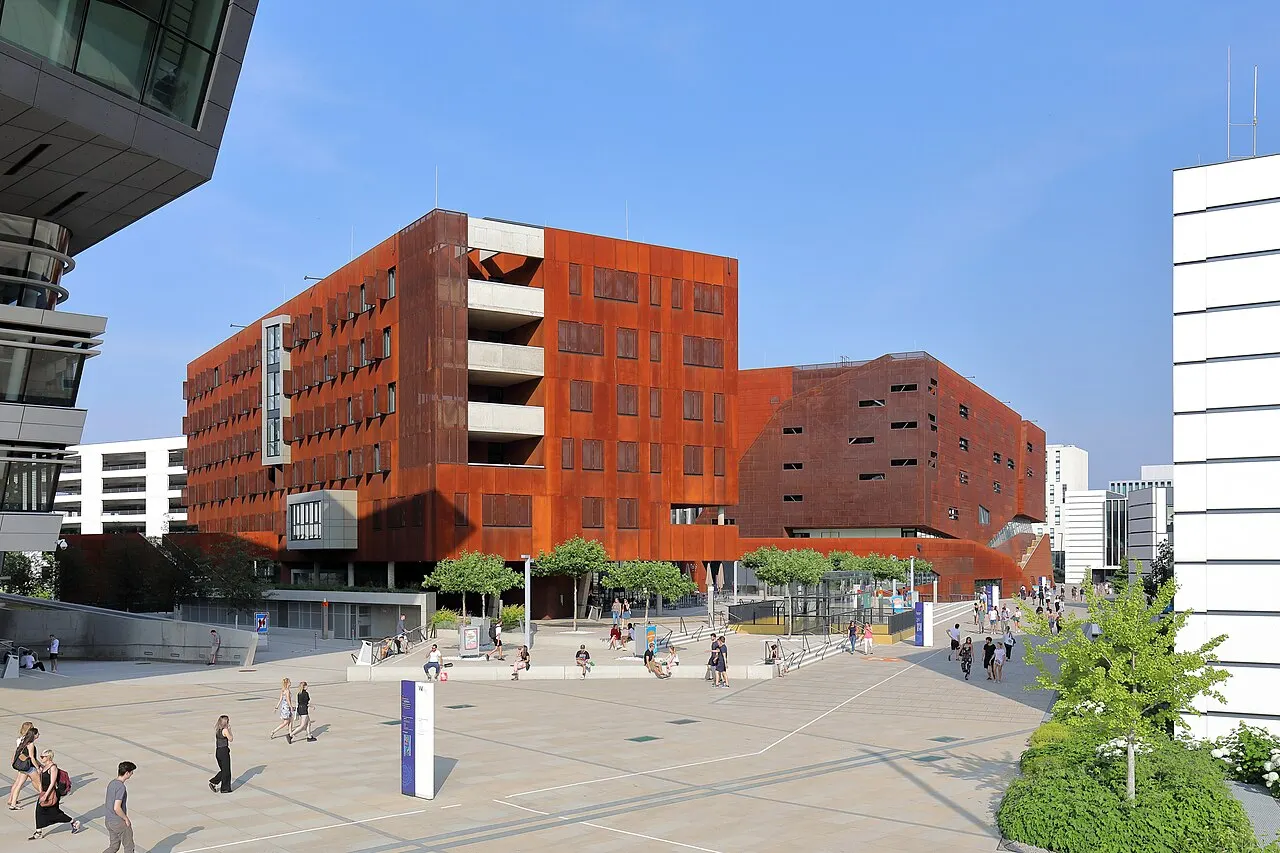
How common English-taught programmes are at each level
Scholway paged through every result of the studienwahl.at English filter on 24 October 2026 and tallied the type shown on each listing. The totals are our own count of a database that changes continuously, so treat them as an order of magnitude rather than an official statistic. The pattern is unambiguous, though.
| Level | Listings | What it means for you |
|---|---|---|
| Bachelor's | 88 | A real but narrow choice. See bachelor's degrees in Austria for the German-taught default. |
| Master's | 420 | The core of the English offer, across all institution types. See master's in Austria. |
| PhD / doctoral | 84 | Supervisor-led; see doctoral study in Austria for how entry works. |
The database used one more label, Erasmus Mundus, once. It listed no entries typed as university courses (Universitätslehrgänge, explained below), so continuing-education programmes taught in English have to be found on the universities' own pages. For universities of applied sciences, Study in Austria separately reports about 80 programmes taught entirely in English out of 640 degree programmes (undated figures). The two OeAD counts and our tally do not match exactly because they were taken at different times from a changing database.
Which universities and FHs offer the most
Large comprehensive public universities list the most English-taught programmes, followed by technical universities. In our tally, the University of Vienna had the most (about 55 listings), then the Central European University (about 46), and the universities of Innsbruck, Graz and Linz (each about 30 to 35). TU Graz and the Montanuniversität Leoben followed with more than 20 each. Among universities of applied sciences, IMC Krems and FH JOANNEUM had about 17 each and FH Upper Austria about 16. These are approximate counts of listings, not of distinct degrees, because a programme may be listed per location or variant.
| Institution type | Example | Level and language | Field |
|---|---|---|---|
| Public university | TU Wien | 26 programmes English-taught master's programmes on its own list, e.g. Data Science, Software Engineering, Logic and Artificial Intelligence, Visual Computing, Technical Physics | Computing, engineering, mathematics, natural sciences |
| Public university | University of Vienna: Mathematical Foundations of Data Science | Bachelor's, taught in English; its admission page says no German is needed | Mathematics and data science |
| Public university | WU Vienna: Business and Economics | Bachelor's (BSc, 180 ECTS), taught fully in English, with a yearly selection procedure | Business and economics |
| Public university | JKU Linz: Artificial Intelligence | Offered as a bachelor's and a master's; JKU's degree-programme page names it as English-taught, alongside the bachelor's International Business Administration | Artificial intelligence, business |
| University of applied sciences | MCI Innsbruck | 11 programmes master's programmes "held entirely in English", e.g. International Business & Management, Biotechnology, Mechatronics - Smart Technologies | Management, health, technology |
| Private university | Modul University Vienna, Webster Vienna Private University | English-language bachelor's and master's programmes (both appear in the studienwahl.at English listing; fees in the cost section below) | Business, tourism, international relations, psychology |
| University continuing education | University of Vienna Postgraduate Center: European Studies | MA (Continuing Education), 120 ECTS, "taught exclusively in English" | European and international affairs |
Arts and music universities (for example the University of Applied Arts Vienna and the University of Music and Performing Arts Vienna) also appear in the English listing, mostly with master's programmes; check each department's own page for its language and admission rules. How the university types differ is explained in public universities, universities of applied sciences and private universities.
- Fachhochschule (FH)Fachhochschule
- A university of applied sciences. Programmes are practice-oriented, have fixed cohorts and are applied for programme by programme, not through general university enrolment.
- Private universityPrivatuniversität
- An accredited, privately run university. It sets its own tuition fees, which the public-university fee rules do not cap.
How to search for English-taught programmes
Start with the official database
Open the English-language filter on studienwahl.at (linked from Study in Austria's "find your programme" page). It is the ministry-backed register, and you can narrow it by location, full-time or extra-occupational format, degree type and institution.
Filter, then open the programme's own page
Use the database to build a shortlist, then confirm language of instruction, curriculum, ECTS and admission rules on the university's page. The database is a pointer, not the final word on a deadline or a fee.
Check the university's English-taught list
Large universities keep their own lists, as TU Wien does for master's degrees. These are usually more current than any aggregator.
Search continuing education separately
Postgraduate centres, such as the University of Vienna's, run English programmes that the studienwahl.at English filter did not return in our check. Their fees are set per programme (see below).
Check admission and language proof together
Admission route, deadline and accepted English tests differ by institution. Put them side by side in a spreadsheet before you apply, and use the application timeline to plan the order.
Be sceptical of commercial aggregator sites. Several repeat figures from earlier years (including fees and deadlines), and an admissions office is the only source that can confirm a current requirement.
In practice: finding the English-taught courses once you are enrolled
A programme listed as English-taught is only the start; each semester you still choose courses one by one. The University of Graz's guide for incoming students shows two things worth copying at any university.
Use the course search's English filter
UNIGRAZonline has a separate search for English-taught courses: choose the study year and your programme, optionally limit it to the winter (W) or summer (S) semester, and click “Search” for a list; each title opens a detail page with lecturer, ECTS and dates.
Read the teaching-language line literally
Graz warns that a course description naming German and English as teaching languages does not necessarily mean it is held in both: the lecture may be in German with English literature. Ask the lecturer before you rely on it.
Keep a fallback
Graz advises registering for more courses than you need, because places go to waiting lists first and fixed places follow after the window closes.
Proving your English
An English-taught programme asks for English proof instead of German proof, usually at B2. The accepted tests and scores are set by each institution; the University of Vienna, for example, accepts IELTS Academic 6.5 overall as B2, and its purely English-taught master's programmes and the bachelor's Mathematical Foundations of Data Science need no German proof. The language requirements guide has the full comparison of tests, certificate age and the exceptions, so this page does not repeat it.
Do you still need German?
For the degree itself, not necessarily: a fully English-taught programme will not require German proof for admission, but this depends on the individual programme, since bilingual programmes need both languages. Outside class the picture changes. Offices, landlords, doctors and most public services work in German, and many jobs expect it; as guidance, assume that part-time work and your first apartment search will be easier with at least basic German. Some English-taught programmes also contain German-language modules, placements or electives, so read the curriculum. The German-in-daily-life guide explains what level helps where, and the hub overview of studying in Austria places this in the wider system.
Tuition: same as German-taught, with exceptions
At a public university the language of instruction does not change the fee. A degree student from a third country who holds a student residence permit and is not in an equal-status group pays €726.72 per semester from the first semester, plus the €26.20 ÖH fee; the standard rate is €363.36 per semester. Citizens of the 46 countries states on the ordinance's annex are exempt at public universities. Turkey is not on that list. The tuition fees guide covers the full rules and waivers, so check there before budgeting.
Three kinds of English programme sit outside that scale, and mixing them up is the most expensive mistake a reader of this page can make.
| Provider type | Who sets the fee | Examples we verified |
|---|---|---|
| Public university, regular degree | The statute (UG § 91) | €726.72 per semester for third-country students on a student permit, €363.36 standard |
| University of applied sciences | The FH, within the FHG: at most €363.36 for regular students, up to cost-covering for third-country students on a student permit | €726.72 (FH Upper Austria, HOK Kufstein), €850 (FH Wiener Neustadt), €8,250 (MCI Innsbruck), all per semester for non-EU students |
| Private university | The university | €9,000 per semester for most Modul University Vienna bachelor's programmes; €12,034 per semester at Webster Vienna |
| University continuing-education programme | The university, per programme | €3,577.50 per semester at the University of Vienna Postgraduate Center (European Studies, plus a deposit) |
- University course (continuing education)Universitätslehrgang (ULG)
- A programme a public university runs outside its regular degree programmes, often for working professionals. Under UG § 56 the university's rectorate sets the participants' fee (Lehrgangsbeitrag), taking the actual costs of the course into account, so it is not the public tuition rate.
A ULG can still carry a master's title, and the law treats certain ULG degrees as equivalent to regular bachelor's and master's studies. The price, however, can be many multiples of the public fee. Fees such as those quoted above change with each start date, so confirm the current figure with the programme office. If you need a student residence permit, ask the programme and the permit authority in advance whether it qualifies; the permit rules are in the residence permit guide.
Admission specifics and deadlines
The admission route depends on the institution type, not the language. At public universities, bachelor's and diploma programmes have a general admission period that, by statute, ends on 5 September for the winter semester. That period applies fully to Austrian and EU/EEA nationals, and the rectorate may set a different special period for other foreign nationals, so non-EU applicants should read the specific university's date. Programmes with an entrance procedure run to their own calendar:
- The University of Vienna's English-taught bachelor's Mathematical Foundations of Data Science: application 2 March to 4 May 2026 and an on-site aptitude test on 15 July 2026, with a €50 cost contribution.
- WU Vienna's English-taught bachelor's Business and Economics: a selection procedure once a year in spring, with applications from 2 March to 19 May 2026 for the October 2026 start.
- Master's programmes: usually an application with transcripts, language proof and often a motivation letter, with dates that differ by university and programme. TU Wien marks some English master's degrees as having a selection procedure.
- FHs and private universities: you apply to the institution for each programme, with its own timetable and often a cohort limit.
Dates above are for the stated 2026 intake and move each year. The deadlines guide and the entrance exams guide explain the mechanics, and the requirements guide lists the documents. Because the English filter mixes institution types, never assume that one university's date applies to another.
Before you shortlist an English-taught programme
- Confirm the language of instruction is fully English on the programme page, not partly.
- Check which English tests and scores the institution accepts, and the certificate's maximum age.
- Find the exact fee for non-EU students, and whether the provider is public, an FH, private or a ULG.
- Check the admission route, deadline and any entrance or aptitude test for your intake.
- Read the curriculum for German-language modules, placements or electives.
- Plan basic German for daily life from the first month.
Frequently asked questions
Can I do a full bachelor's degree in English in Austria?
Yes, but the choice is narrow. The official studienwahl.at English filter returned 88 listings bachelor's listings on 24 October 2026, against 420 listings master's listings. Examples include WU Vienna's Business and Economics and the University of Vienna's Mathematical Foundations of Data Science.
Do I need German to study in an English-taught programme in Austria?
Not for admission to a fully English-taught programme, which asks for English proof instead. Daily life, many jobs and some modules or electives still use German, so basic German helps from the start. Bilingual programmes need both languages.
Is tuition cheaper or more expensive for English-taught programmes?
At a public university the fee is the same as for a German-taught degree. A third-country student on a student permit pays €726.72 per semester. FHs, private universities and continuing-education programmes set their own, often much higher, fees.
Does my English-medium degree from Turkey count as proof of English?
At the universities of Vienna and Innsbruck, a degree taught in English counts without a test only if obtained in the EU/EEA, Switzerland, the UK, the USA, Australia, New Zealand or Canada. A Turkish English-medium degree does not exempt you there, so plan for IELTS, TOEFL or another accepted test.
What is the difference between a master's degree and a ULG taught in English?
A regular master's degree is charged at the statutory public rate. A Universitätslehrgang is a university course whose fee the rectorate sets from the programme's actual costs, so it is typically priced per programme. Ask whether the specific programme qualifies for a student residence permit before you pay.
Where is the best place to find English-taught programmes in Austria?
Start with the English filter on studienwahl.at, then check each programme on the university's own page, since admission rules, deadlines and fees come from the institution. University lists such as TU Wien's English-taught master's page are usually the most current.
Sources
12 sources, all official
- Programmes in English – Studienwahl.at study searchFederal Ministry for Women, Science and Research (BMFWF) (Official)
- Find your programmeOeAD – Study in Austria (Official)
- University of Applied SciencesOeAD – Study in Austria (Official)
- English-taught Master's ProgrammesTU Wien (Official)
- Master's programmesMCI Innsbruck (Official)
- Bachelor's Programme Business and EconomicsWU Vienna (Official)
- Anleitung: Anmeldung zu Lehrveranstaltungen in UNIGRAZonlineUniversität Graz (Official)
- Mathematical Foundations of Data Science (bachelor's programme)University of Vienna - Admission procedures (Official)
- European StudiesUniversity of Vienna - Postgraduate Center (Official)
- International LawUniversity of Vienna - Postgraduate Center (Official)
- UG 2002 § 56 UniversitätslehrgängeRIS - Federal Chancellery (Official)
- Study programmes in EnglishOeAD / Study in Austria (Official)