In Austria a master's is the second cycle after a bachelor's. At a public university the Universities Act sets a minimum of 120 ECTS credits for a master's, which at 30 credits per semester means four semesters (UG § 54 Abs. 3). The Act also lowers the minimum to 60 ECTS credits where the bachelor's you are admitted on had 240 ECTS, and a Fachhochschule (FH) may run master's programmes of 60, 90 or 120 ECTS (FHG § 3 Abs. 2). A shorter programme is therefore legal, but it is not what you should expect by default: TU Wien, for example, lists its master's programmes as four semesters and 120 ECTS.
At a glance: a master's in Austria for non-EU students
| Topic | Short answer |
|---|---|
| Tuition | €726.72 per semester for most non-EU students on a student permit, plus the ÖH (student union) fee of €26.20 per semester. FHs and private universities set their own fees: see tuition fees. |
| Living costs | OeAD's non-binding guideline for total living expenses is about €1,300 per month; Vienna and other large cities cost more. See cost of living. |
| English-taught master's | The official studienwahl.at database returned 420 listings for master's programmes in English on 24 October 2026. See English-taught programmes. |
| Length | Four semesters and at least 120 ECTS credits at a public university; as few as 60 ECTS credits after a 240-ECTS bachelor's, and 60, 90 or 120 ECTS at an FH. |
| Entry requirement | A completed bachelor's that is relevant to the master's field; the usual benchmark is six semesters and 180 ECTS (UG § 64). A four-year Turkish lisans clears the duration floor. See admission requirements. |
| Language proof | English-taught programmes ask for English, usually at B2, and German-taught ones for German; each programme sets its own level. An English-medium degree from Türkiye does not replace a test: see language requirements. |
| Application windows | Set per university and programme. TU Wien advises non-EU/EEA applicants to file a complete application from 16 January to 15 July for the winter semester, and WU Vienna's priority deadlines for 2027/28 are 8 October 2026, 8 January 2027 and 8 March 2027. See application deadlines. |
| Working while you study | Up to 20 hours per week without a labour-market test, but you still need an employment permit. See working hours for students. |
| After graduation | The student permit can be extended once for 12 months to look for work or start a business; the extension is discretionary. See the job-seeker permit. |
Admission turns on one test: does your bachelor's (or an equivalent degree) fit the master's field, and does it come from a recognised post-secondary institution? The general requirements for non-EU applicants are in admission requirements; this guide covers the master's-specific part, the selective programmes, the thesis and degree titles, and the steps after graduation. English-taught options are listed in English-taught programmes: the official database returned 420 listings master's listings in English on 24 October 2026.
How a master's is structured, and who offers one
Four kinds of institution award master's-level qualifications in Austria, and they are not interchangeable. The table sets out the differences that matter before you apply. The wider system is explained in the Austrian higher education system.
| Type | Workload | Who sets admission | Fees |
|---|---|---|---|
| Public university (ordinary master's) | At least 120 ECTS credits; 60 ECTS minimum if the underlying bachelor's had 240 ECTS (UG § 54 Abs. 3) | Statute (UG § 64 Abs. 3) plus the university and, for some programmes, a selection procedure | Statutory tuition: €726.72 per semester for most third-country students on a student permit; see tuition fees |
| Fachhochschule (FH) master's | 60, 90 or 120 ECTS (FHG § 3 Abs. 2) | FHG § 4 plus the programme; every programme runs its own selection (see universities of applied sciences) | Capped at €363.36 per semester for regular students, but third-country students on a student permit may be charged cost-covering fees (FHG § 2 Abs. 2) |
| Private university | Set in the accredited programme; see private universities | The institution | Set by the institution; the public-university fee rules do not apply |
| University continuing-education course (Universitätslehrgang, ULG) with a "Master of …" title | 120 ECTS credits for an extraordinary master's, with a possible shorter exception (UG § 56 Abs. 2) | The university, within § 56 | A course fee (Lehrgangsbeitrag) the rectorate sets from the actual costs (UG § 56 Abs. 5); not the statutory tuition |
- ECTS creditECTS-Anrechnungspunkt
- A unit of workload. Under UG § 54 Abs. 2 a study year is 1,500 actual hours and 60 credits, so one credit stands for about 25 hours including self-study and exam preparation.
- Universitätslehrgang (ULG)Universitätslehrgang
- A university continuing-education course. Participants pay a course fee set from actual costs, and the awards are titled "(Continuing Education)", MBA or LL.M. rather than the ordinary master's titles.
Admission: which bachelor's qualifies
UG § 64 Abs. 3 asks for a bachelor's degree that is "fachlich in Frage kommend", meaning relevant to the field. A different relevant degree of at least the same level from a recognised domestic or foreign post-secondary institution also counts, as does a study defined in the master's curriculum. The statute sets no ECTS figure for the master's entry degree itself. The general entry rule in § 64 Abs. 1 Z 3 recognises a completed study of at least three years (full-time) or 180 ECTS, which is why the usual benchmark for a bachelor's is six semesters and 180 ECTS. TU Wien requires that you have completed all prescribed credits (at least 180 ECTS) and have no exam entitlement left before you apply.
How the relevance check works depends on the university. At TU Wien the dean of studies compares your degree with the corresponding TU Wien bachelor's. If it is largely equivalent you are admitted. If there are differences you are admitted with conditions: additional courses from the bachelor's that you take as supplementary exams during the master's. TU Wien states that if the differences exceed 30 ECTS credits, admission is not possible. BOKU allows a maximum of 30 ECTS credits of additional courses for a related but different bachelor's. These caps are published university practice and not in the statute, so another university may handle it differently.
Supplementary exams and conditional admission
This is the statutory part. To balance substantial subject differences, UG § 64 Abs. 3 lets the university prescribe supplementary exams (Ergänzungsprüfungen) that must be passed by the end of the master's first 2 semesters, that is, by the end of the second semester. The rectorate can also decide which of them are prerequisites for exams in the master's curriculum. The statute speaks of exams, not of a number of credits. The Act's version of conditional admission is therefore admission now with subject debts to clear in your first year, not admission on the basis of a bachelor's you have not yet finished. TU Wien and the University of Vienna both require the bachelor's to be complete at application, and the University of Vienna names an exception for master's programmes with a selection procedure. WU Vienna states that proof of finishing your first degree is not required until actual enrolment.
Turkish four-year bachelor's degrees
A Turkish lisans degree normally runs four years, so it clears the three-year or 180-ECTS floor that the statute and the universities cited here use. None of the Austrian university pages checked for this guide treats a four-year Turkish degree as a problem or gives it special weight on duration. What decides admission is relevance to the master's, assessed against your transcript and course contents. Two points are published. First, BOKU lists an extra country-specific requirement for master's applicants from Turkey: the ALES test, in addition to the general requirements. Second, the University of Vienna's country page for non-EU applicants has no Türkiye entry in its master's section, which means the general rule and the individual check apply, though the page is silent on what that entails. Some other universities set duration thresholds by country (TU Graz, for example, applies a four-year rule to bachelor's degrees from Bangladesh), so do not assume duration is a safe proxy for admission anywhere.
Nostrification, the formal recognition of a foreign degree, is a separate procedure and is not named as a condition in § 64 Abs. 3; see degree recognition. English-taught degrees from Turkey do not exempt you from English tests: see language requirements. A Turkish national also needs a visa to travel to Austria, so the application chain ends with the permit procedure described in the residence permit guide.
| Institution | Completed bachelor's needed at application? | Subject gaps | Applications |
|---|---|---|---|
| TU Wien | Yes: all credits (at least 180 ECTS) completed; a confirmation of completion plus transcript is accepted while the certificate is awaited | Admission with conditions; refused if gaps exceed 30 ECTS credits | Written application; non-EU/EEA applicants are advised to submit complete files between 16 January to 15 July for winter |
| BOKU University | Evidence of completed previous studies; Turkey adds the ALES test | Up to 30 ECTS credits of additional courses, due by the end of the second semester | By post or in person only; not online or by email |
| WU Vienna (English-taught master's) | Not for SIMC at application; proof is due at enrolment | Programme-specific prerequisites, for SIMC 45 ECTS credits in business or economics | Priority deadlines 8 October 2026, 8 January 2027 and 8 March 2027 for the 2027/28 intake |
Selective master's programmes
Meeting the entry requirement does not always give you a place. Some public-university master's programmes admit through a selection procedure (Aufnahmeverfahren), usually with separate dates from the ordinary application window. The examples below are programmes whose procedures were published on 24 October 2026; they illustrate the pattern and are not a full list.
- WU Vienna. Each English-taught master's has its own application and admission procedure. For Strategy, Innovation and Management Control (SIMC), the 2027/28 requirements include a bachelor's of at least 180 ECTS with 45 ECTS credits in business administration or economics, an English proof, and a GMAT result of 600 (GMAT Online) or 565 (GMAT Focus Edition) points. Selection runs through document screening, a motivation letter written within 72 hours, a video interview and an online group discussion. WU's English-taught master's list showed nine programmes on 24 October 2026; the others have their own requirements. WU advises third-country nationals to use the first priority deadline because the residence-permit procedure is demanding.
- TU Graz. Master's programmes with an admission procedure register and upload documents between 15 October to 15 December 2026, for admission in 2027/28. A selection commission ranks applicants on prior qualifications and a letter of motivation, and TU Graz states that even with fully equivalent qualifications a place is not guaranteed. Graduates of TU Graz are exempt, as are, for NAWI Graz programmes, University of Graz graduates.
- TU Wien. Most master's admissions work through the written application above. TU Wien names Building Science and Environment and Green Chemistry as master's programmes that add an admission procedure at pre-registration.
Applying from Türkiye, step by step
This is the usual order for an applicant who lives in Türkiye and applies to a public university. Each step links to the guide that holds the detail, and the dates always come from the programme you apply to.
Choose the programme
Shortlist programmes in the official database, compare each curriculum with your bachelor's transcript, and note the language of instruction, the fee and whether the programme runs a selection procedure. English-taught options are listed in English-taught programmes, and the institution types are compared in Austria's universities.
Check the requirements
Your bachelor's must be relevant to the master's field and meet the three-year or 180-ECTS floor, which a four-year Turkish lisans clears. Add the language proof and any country-specific extra, such as BOKU's ALES test. The full list is in admission requirements and language requirements.
Prepare the documents
Your degree certificate and transcript get an apostille in Türkiye and, unless they are in German or English, a translation by a court-certified translator, in the form the university asks for. See admission documents and apostille and translation.
Apply by the deadline
Apply to each programme in its own window. Universities often set an earlier window for non-EU applicants, and WU advises third-country nationals to use its first priority deadline because the residence-permit procedure is demanding. Plan the chain with application deadlines and the application timeline.
Receive the admission decision
If the university admits you with conditions, the decision lists the supplementary exams to pass by the end of the second semester (see the admission section above). Keep the admission letter: it belongs in the residence-permit file.
Apply for the residence permit
Book an appointment and file the student permit application in person at the Austrian Embassy in Ankara or the Consulate General in Istanbul, depending on your province of residence. After approval a visa-required student gets a Visa D to travel and collect the card in Austria. See the application process and the residence permit guide.
Arrive and register
You must register your address within 3 days of moving in and collect the residence card in person within 6 months of the approval notice. The order of everything else in the first month is in the first 30 days.
Costs, duration and tolerance semesters
Costs depend on the institution type and on your status, and the amounts are kept in one place: tuition fees and the mandatory student-union fee of €26.20 per semester. A third-country student on a student permit at a public university pays the statutory tuition (€726.72 per semester) from the first semester. The "fee-free" tolerance rule is therefore not relevant to you in the usual case: it gives EU/EEA/Swiss and equal-status students a fee-free period of the planned duration plus 2 tolerance semesters beyond it, with 30 ECTS counting as one semester for master's programmes. If the master's is taught at an FH, a private university or as a ULG, the fee can be far higher; see the table above.
Duration matters for another reason. Your residence permit is renewed against study progress, not against the plan in the curriculum, so a master's that stretches into extra semesters because of a late thesis also stretches your costs and your permit paperwork. The progress rule is in renewal of the student permit.
Thesis, final exam and degree titles
A master's includes a master's thesis (Masterarbeit). UG § 81 Abs. 1 requires one, though a curriculum for a particularly career-oriented study other than teacher education may substitute an equivalent work. A thesis written as a timed exam is not permitted. The topic must be chosen so that a student can complete it within 6 months (§ 81 Abs. 2), which is a design rule for the topic and not a deadline. A thesis may be written jointly if each student's contribution can be assessed separately. Supervision and assessment rules sit in each university's statutes, and the topic rules in the curriculum. Citation and integrity expectations are covered in plagiarism rules, and grading in the grading system.
Under UG § 87 Abs. 1 the university confers the degree by a written decision once all curriculum exams are passed and the thesis is delivered and positively assessed, and it must do so ex officio no later than 1 month after the last condition is met. Whether your curriculum ends with a defence or a final oral exam is set in the curriculum, so read it; see also oral exams. A diploma supplement and an English translation of the decision come with the degree document.
| Where | Title | Basis |
|---|---|---|
| Public university | "Master" with a curriculum-set addition and abbreviation, or Diplom-Ingenieurin/Diplom-Ingenieur (Dipl.-Ing. or DI) | UG § 51 Abs. 2 Z 11. TU Wien lists its master's degree as Dipl.-Ing., "internationally comparable with Master of Science (MSc)" |
| Public university, teaching | Master of Education (MEd) | UG § 51 Abs. 2 Z 11 |
| FH | "Master …" or "Diplom-Ingenieurin/Diplom-Ingenieur …" with a subject addition fixed in the programme's accreditation | FHG § 6 Abs. 2 |
| ULG (extraordinary master's) | MA (CE), MSc (CE), MEng (CE), Master Professional (MPr), MBA, EMBA or LL.M. | UG § 87 Abs. 2 |
- Fachlich in Frage kommendfachlich in Frage kommendes Bachelorstudium
- The statute's phrase for a bachelor's that is relevant to the master's field. The university decides relevance by comparing curricula; it is not a list of approved degrees.
- ErgänzungsprüfungErgänzungsprüfung
- A supplementary exam prescribed on admission to close substantial subject differences. For a master's at a public university it must be passed by the end of the second semester (UG § 64 Abs. 3).
In practice: from thesis submission to the ceremony
The statute fixes the frame; the faculty runs the steps. The University of Graz's Humanities faculty publishes them in full, and TU Wien's faculties publish theirs, with different details. Read your own faculty's page before you start writing.
Choose a supervisor
At Graz Humanities the supervisor must be habilitated or hold a teaching qualification (venia docendi); the dean of studies may appoint someone who is not.
Announce topic and supervisor first
Send the form to the dean's office before you start writing. A new topic needs your supervisor's consent and a new form; the supervisor can be changed until submission with a form that includes the previous supervisor's agreement.
Upload in UNIGRAZonline
In the “My theses” app, upload the thesis and abstracts as PDF/A: German and English abstracts of at most 4,000 characters including spaces each, plus one in the thesis language if it is another. Click “Submit now”; your supervisor is e-mailed. A sworn statement must not be inside the thesis, for data-protection reasons.
Wait for the checks and the grade
After the supervisor approves, a plagiarism check runs and you are e-mailed when its report goes to the reviewer. The supervisor must assess the thesis within 2 months after submission of submission.
Register for the committee exam
Only after a positive grade, on the faculty's form. The exam must come at least 4 weeks after submission and at the earliest 2 weeks after the expert report reaches the dean's office.
TU Wien's two faculties read for this guide differ from Graz and from each other. Mechanical and Industrial Engineering makes the electronic upload in TISS mandatory and wants the documents at the dean's office 3 weeks before a master's exam. Civil and Environmental Engineering (leaflet of 29 August 2023) has you register in TISS, with both examiners already fixed, and then send the documents electronically through a link it e-mails you.
What one TU Wien faculty asked for with the submission (leaflet of 29 August 2023)
- Birth certificate; the admission notice if your bachelor's was not at TU Wien
- Certificates that could not be imported from TISS, and any recognition decisions
- The form signed by both examiners and a current study sheet
- The assessment of the thesis and a sworn declaration
- One bound copy with an English summary, and a copy of the title page
- The UStat2 confirmation from Statistik Austria's graduate questionnaire
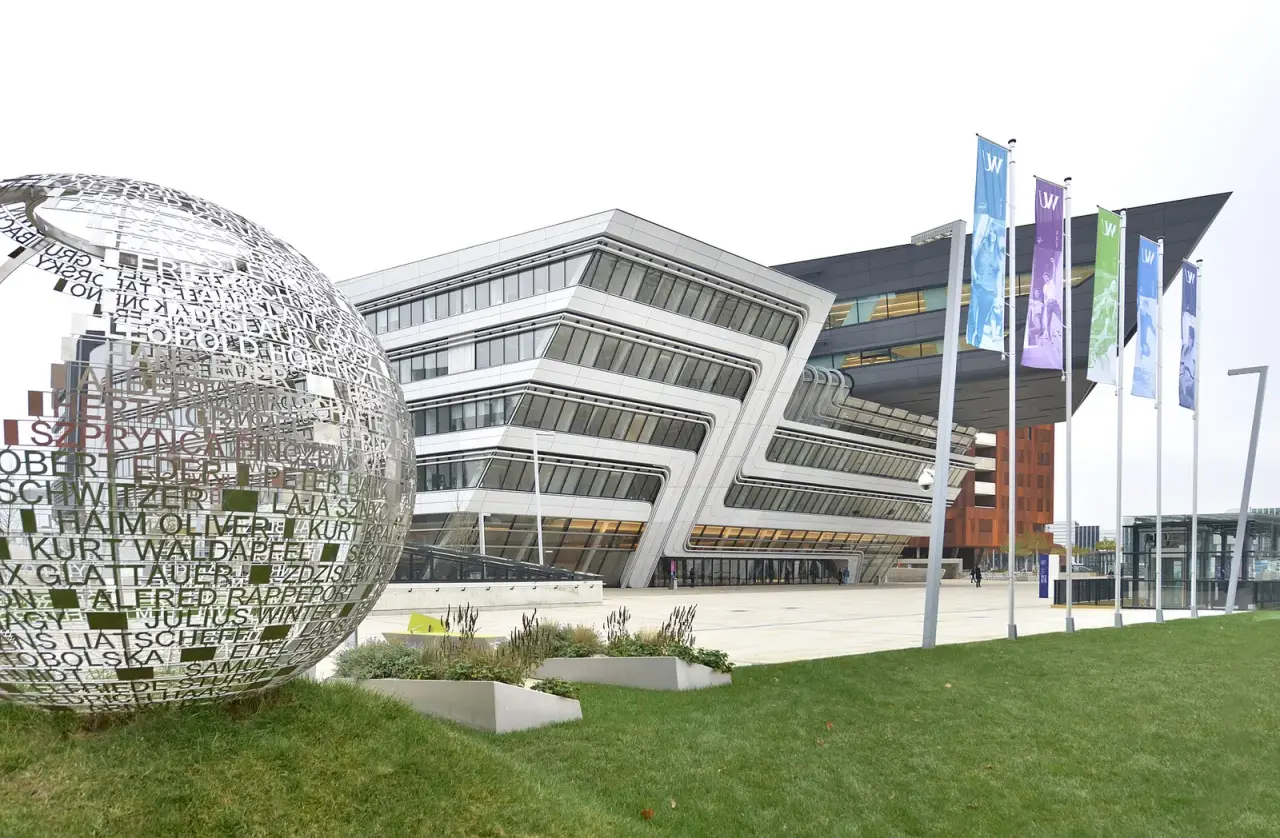
The Sponsion, the graduation ceremony, is optional and run by each university. One WU master's programme (Taxation and Accounting) holds its ceremony once a year in autumn, if enough graduates register, in Festsaal 1 of the Library & Learning Center; you report completion electronically at least 4 weeks before the registration deadline, which usually falls a week before the ceremony. WU's leaflet describes the order: a briefing 30 minutes before, then the graduates enter alphabetically and the sponsors to Gaudeamus igitur. After the speeches the sponsion formula is read; as your name and thesis title are called you step forward, put your fingers on the sceptre and say “spondeo”, “Ich gelobe” or “I pledge”, and receive your certificate. TU Wien's civil engineering faculty asks you to register at the dean's office 2 weeks before and to pay €25 in cash, for photographer, flowers and folders; at Graz's social and economic sciences faculty you register only through the Studienabteilung, and only once you hold the final certificate. The documents themselves are covered in the grading guide.
Working during a master's
Third-country students on a student permit can obtain an employment permit without a labour-market test for up to 20 hours per week, but the permit itself is still required, and a master's with supplementary exams and a thesis leaves less room than the number suggests. The hour limits, the permit procedure and the exceptions for EU students are in working hours for students.
After the master's: work, a doctorate or both
Graduates may be able to extend their student permit once for 12 months to look for work or set up a business (§ 64 Abs. 4 NAG); the extension is discretionary and depends on aiming for a Red-White-Red Card, Blue Card or researcher permit. The route is explained in the job-seeker permit guide. For a doctorate you need a relevant master's or diploma from a recognised institution (UG § 64 Abs. 4), with supplementary exams possible under the same two-semester rule; an FH master's entitles you to a relevant doctorate at a university, and the doctorate is lengthened where the FH programme is shorter than the university equivalent (FHG § 6 Abs. 4). See doctoral studies in Austria.
Timeline from application to graduation
12 to 18 months before the start
Shortlist programmes
Check relevance of your bachelor's against each curriculum, the English proof, and whether the programme has a selection procedure.
Autumn before the start year
Early deadlines
WU's first priority deadline for 2027/28 is 8 October 2026. TU Graz's registration period for programmes with an admission procedure is 15 October to 15 December 2026.
Winter to spring
Remaining deadlines and decisions
WU's later priority deadlines are in 8 October 2026, 8 January 2027 and 8 March 2027. TU Graz announces rankings by 1 March 2027. TU Wien recommends non-EU/EEA applicants file between 16 January to 15 July for the winter semester.
After the admission decision
Permit and enrolment
Apply for the student residence permit (see the application process).
Spring to summer
Applications without a selection procedure
TU Graz's submission window for third-country applicants to master's programmes without an admission procedure, with an international degree, is 1 May – 15 August for the winter semester. Other universities set their own windows.
Semesters 1 to 2
Supplementary exams, if prescribed
Pass them by the end of the second semester.
Semesters 3 to 4
Thesis and final requirements
Agree the topic and supervisor, deliver the thesis, take any final exam the curriculum prescribes.
Within a month of the last requirement
Degree decision
The university issues the degree decision ex officio (UG § 87 Abs. 1).
Checklist before you apply
- Your bachelor's is complete, or the programme explicitly accepts a pending degree
- You have compared your transcript with the curriculum and know which subjects may be prescribed as supplementary exams
- Language proof for the programme's language is ready, and Turkish-issued English-medium degrees are not assumed to replace a test
- Documents are legalised and translated as the university requires; see admission documents
- You have checked whether the programme has a selection procedure and its separate dates
- You know the fee for your institution type and status, and have budgeted the permit means
- You have checked any country-specific extra (for example BOKU's ALES test for Turkey)
Frequently asked questions
What are the requirements for a master's in Austria?
The core requirement is a completed bachelor's degree relevant to the field (UG § 64(3)); if there are subject gaps, the university can prescribe supplementary exams to be passed by the end of the second semester of the master's. On top come proof of the language of instruction, legalised and translated documents and, for some programmes, a selection procedure. The University of Vienna does not accept applications before the bachelor's is finished, except for programmes with a selection procedure. Details: admission requirements and language requirements.
Is a master's degree in Austria free?
Not for most non-EU students. At a public university a third-country student on a student permit pays €726.72 per semester from the first semester, plus the €26.20 ÖH fee that every student pays each semester. EU/EEA and equal-status students pay no tuition for the planned duration plus 2 tolerance semesters beyond it, and FHs and private universities can charge much more. See tuition fees.
Can I do a master's in Austria without speaking German?
Yes, if the programme is taught in English. The official database returned 420 listings for master's programmes in English on 24 October 2026, and OeAD's own count is around 600 programmes taught in English. You prove English instead of German, usually at B2, though daily life outside the university is easier with some German. See English-taught programmes.
Do I need ALES or YKS for a master's in Austria?
It depends on the university: the published rules differ. BOKU lists the ALES test for master's applicants from Turkey. Some universities ask school-leavers from Türkiye for the national entrance exam (ÖSYS/YKS or YÖS); the University of Vienna drops that proof if you already hold a completed degree of at least three years or 180 ECTS, and its master's section has no Türkiye entry. Read the programme's own page and the admission requirements.
Can I work while doing a master's in Austria?
Yes, with a permit. A third-country student on a student permit can obtain an employment permit without a labour-market test for up to 20 hours per week, but the permit itself is still required. Supplementary exams and the thesis can leave less time than that number suggests. See working hours for students.
Which universities are best for an English-taught master's in Austria?
There is no single best one; it depends on your field and on whether your bachelor's fits the curriculum. TU Wien's own page lists 26 English-taught master's programmes, MCI Innsbruck lists 11 held entirely in English, and WU Vienna's English-taught list showed nine master's programmes on 24 October 2026. Compare institutions in Austria's universities, treat rankings as a sanity check only, and start from English-taught programmes.
How long is a master's degree in Austria?
At a public university it has at least 120 ECTS credits, which is four semesters at 30 credits each, or about two years full-time; TU Wien lists four semesters and 120 ECTS for its master's programmes. The law allows 60 ECTS where the bachelor's had 240 ECTS, and FH master's programmes are 60, 90 or 120 ECTS. Check the curriculum of the programme you are applying to.
Can I get into an Austrian master's with a Turkish four-year bachelor's?
Duration is not the hurdle: four years clears the three-year or 180-ECTS floor. The university decides whether the degree is relevant to the master's, and may prescribe supplementary exams. BOKU additionally lists the ALES test for master's applicants from Turkey, so check the requirements of each programme.
What are supplementary exams and when must I pass them?
They are exams a public university may prescribe on admission to close substantial subject differences between your bachelor's and the master's. Under UG § 64 Abs. 3 they must be passed by the end of the second semester of the master's. The statute does not set a credit cap; TU Wien and BOKU publish a practice cap of 30 ECTS credits.
Can I apply for a master's before I finish my bachelor's?
It depends on the institution. TU Wien accepts applications only once the bachelor's is complete, but accepts a confirmation of completion with a transcript while you await the certificate. WU Vienna states that proof of finishing your first degree is not required until enrolment, and the University of Vienna names an exception for master's programmes with a selection procedure.
Is a master's at an FH or a private university different from a university master's?
Yes. FH master's programmes follow FHG § 3 and § 4, every programme has its own selection, and third-country students on a student permit can be charged cost-covering fees. Private universities set their own admission rules and fees. See the comparison table above and the guides on universities of applied sciences and private universities.
What do Austrian master's graduates get called?
At a public university the title is "Master" with a curriculum-set addition, or Dipl.-Ing. in engineering fields; teaching master's award the MEd. FH degrees use "Master …" or "Diplom-Ingenieur …" with a subject addition. Continuing-education courses award titles such as MSc (CE), MBA or LL.M.
Can I stay in Austria after finishing my master's?
You may be able to extend your student permit once for 12 months to look for work or start a business, if you aim for a Red-White-Red Card, Blue Card or researcher permit (§ 64 Abs. 4 NAG). The extension is discretionary.
Sources
22 sources, all official
- Universitätsgesetz 2002 § 54 – Ordentliche StudienRechtsinformationssystem des Bundes (RIS) (Official)
- Masterarbeit (Geisteswissenschaftliche Fakultät)Universität Graz, Geisteswissenschaftliche Fakultät (Official)
- Abschlusszeugnis und Sponsion (Sozial- und Wirtschaftswissenschaften)Universität Graz, Sozial- und Wirtschaftswissenschaftliche Fakultät (Official)
- Informationen zum StudienabschlussTU Wien, Fakultät für Maschinenwesen und Betriebswissenschaften, Dekanat (Official)
- Information zur Diplom-/Masterprüfung (Stand 29.08.2023)TU Wien, Fakultät für Bau- und Umweltingenieurwesen, Dekanat (Official)
- Akademische Abschlussfeier Master: AblaufWU Wien, Prüfungsorganisation (Official)
- Mastersponsion (Master Steuern und Rechnungslegung)WU Wien (Official)
- Universitätsgesetz 2002 § 64 – Allgemeine Universitätsreife (Universitätszugang)Rechtsinformationssystem des Bundes (RIS) (Official)
- Universitätsgesetz 2002 § 51 – Studienbegriffe (Mastergrade, Z 11)Rechtsinformationssystem des Bundes (RIS) (Official)
- Universitätsgesetz 2002 § 81 – Diplom- und MasterarbeitenRechtsinformationssystem des Bundes (RIS) (Official)
- Universitätsgesetz 2002 § 87 – Verleihung akademischer GradeRechtsinformationssystem des Bundes (RIS) (Official)
- UG 2002 § 56 UniversitätslehrgängeRIS - Federal Chancellery (Official)
- Fachhochschulgesetz §§ 3, 4 und 6 (ECTS, Zugang, akademische Grade)Rechtsinformationssystem des Bundes (RIS) (Official)
- Zulassung mit Bachelorabschluss einer anderen nationalen oder internationalen Universität/FHTU Wien (Official)
- Master's programmes (key facts: duration, credits, degree)TU Wien (Official)
- Admission Master’s programme with admission procedureTU Graz (Official)
- Admission to a master’s programme with international educational backgroundBOKU University (Official)
- Admission to a master’s programme with international educational background: TurkeyBOKU University (Official)
- Application & Admission – Strategy, Innovation and Management ControlWU Vienna (Official)
- WU Vienna’s English-Taught Master’s ProgramsWU Vienna (Official)
- European StudiesUniversity of Vienna - Postgraduate Center (Official)
- Länderspezifische Voraussetzungen für die Zulassung / Country-specific requirements for admissionUniversität Wien (Official)