What a Fachhochschule is
- University of applied sciencesFachhochschule (FH), also Hochschule für Angewandte Wissenschaften
- A higher education institution offering what the Fachhochschulgesetz (FHG) calls scientifically grounded professional education at university level. The FHG makes an FH's tasks plain: degree programmes on university level serving a scientifically or artistically grounded professional training, with practice-based teaching and the ability to solve the tasks of a given professional field.
Fachhochschulen are the youngest part of Austrian higher education — the sector has existed only since the 1994/95 academic year — but it is no longer a niche. In winter semester 2024 roughly 31% of everyone starting a first degree at an Austrian higher education institution began at a Fachhochschule. The science ministry describes their defining feature as a focus on scientifically grounded professional education at university level, with research concentrated on applied research and development. Where they sit in the wider system, next to the other university types and the structure of studying in Austria, is covered in the linked guides.
How an FH differs from a public university
An FH and a public university both award recognised bachelor's and master's degrees, but they are built for different purposes. The public university combines teaching with research and leans on basic research; the Fachhochschule exists to train you for a profession. That one difference produces all the others:
- Practice and industry orientation. FH curricula are built around a professional field, and the law writes a compulsory internship into every FH bachelor's programme: the Berufspraktikum is a training-relevant part of the degree, and the study time is not extended to fit it. Programmes concentrate on engineering and technology, business, health sciences and social work.
- Fixed cohorts and a set timetable. The number of students per year and programme is limited, so you study in a fixed group moving through a planned schedule together. Attendance rules are set per programme in its curriculum and study regulations — there is no national law of its own mandating attendance — but the structured, school-like format is what makes an FH feel so different from the self-organised public university.
- Applied research. An FH's research is application-oriented: the sector cooperates with roughly 1,900 companies, about 60% of them small and medium-sized firms, and describes itself as generating knowledge on the basis of applied, practice-oriented research. You may do a project with a company partner, but you are not embedded in a basic-research machine the way a university master's student can be.
- Same degree levels, different character. An FH degree and a university degree sit at the same level of the Bologna framework and are equally usable for the labour market and for further study. What differs is how you are admitted, how the teaching is organised, and how much research you are exposed to.
If you want a structured, career-focused route with a compulsory placement and a known end date, the FH model is often the better fit; if you want freedom to shape your own studies or plan a doctorate, the public university is the natural home.
Degrees: bachelor's and master's, but no FH doctorate
Fachhochschulen award bachelor's and master's degrees. The law fixes the workload: a Fachhochschule bachelor's degree is 180 ECTS (usually six semesters), and a master's is 60, 90 or 120 ECTS, most commonly 120 ECTS over four semesters. Both end in a thesis and an examination — a Bachelorarbeit plus a final exam at bachelor's level, and a Masterarbeit plus a final comprehensive exam at master's level. Many programmes can also be studied berufsbegleitend (extra-occupational), organised around a working student's schedule.
One thing a Fachhochschule cannot do is award a doctorate. Under FHG § 4 Abs. 3 the only regular degree studies at an FH are bachelor's and master's programmes, so the PhD is not an FH qualification. FH graduates who want one continue at a university: in winter semester 2025 the sector's umbrella body counted 757 FH graduates enrolled in doctoral studies at Austrian universities. If a doctorate is your end goal, see PhD and doctoral study in Austria — you will most likely spend it at a university rather than an FH.
The scale of the FH sector
Austria has 21 Fachhochschulen, which together ran 564 degree programmes in 2025/26 — split between bachelor's and master's level — with 60,960 students enrolled in winter semester 2024. Around 80 programmes are taught entirely in English; treat that figure as an order of magnitude rather than a precise count, because the page that states it carries no date and the sector's own body puts the English-taught share at roughly a fifth of all FH studies. English-taught options are concentrated at master's level, so a German-speaking bachelor's route is the more common starting point; see English-taught programmes in Austria.
Since 2024 the law has also let an accredited Fachhochschule call itself a Hochschule für Angewandte Wissenschaften, and several now do — one reason institution names differ. For example the institution long known as FH St. Pölten now operates as USTP. The name change does not alter what the institution is: it remains a Fachhochschule under the FHG.
Admission: an entrance procedure, not open access
Because every FH programme has a limited number of study places, admission does not work like the open door at many public university programmes. Most FH programmes run an admission procedure — usually written documents, written or oral tests and an interview — and the closing dates are set per institution and can fall many months before the semester. You apply directly to the FH, normally online.
Two features of FH admission are worth knowing before you start. First, the FHG opens a second door that public universities offer less readily: a relevant vocational qualification, usually combined with additional exams, can take the place of the general university entrance qualification. Second, an FH may require a specific language for a programme and ask you to prove it. The full mechanics — documents, deadlines, and how the FH route compares with a public or private application — are in how to apply to Austrian universities.
What a Fachhochschule costs
Fachhochschulen charge under a different rule from public universities. The FHG lets an FH charge regular students at most €363.36 per semester, but it may instead charge cost-covering fees to third-country students who hold a 'Student' residence permit and fall outside the Persons Groups Ordinance. That second route is not capped at the standard rate, which is why an FH's prices for third-country students spread much wider than a public university's: FH Upper Austria and HOK Kufstein charge €726.72, FH Wiener Neustadt charges €850, and MCI Innsbruck lists €8,250 per semester on some programmes. Many FHs also charge EU students from the first semester, where a public university would not.
The complete fee scale, the exemptions and how FH fees compare with public and private ones are in tuition fees in Austria.
In practice: how an FH starts the year
Because an FH admits a fixed cohort, onboarding is organised for the group. MCI Innsbruck's report on its 2025 orientation days for new international full-degree students shows the pattern (online from 1 September 2025; on site on 29 and 30 September 2025): sessions on Austrian culture, life in Innsbruck and the essentials on visa, residence registration and insurance; on-site sessions on well-being abroad, move-in essentials and academic success; a city-wide treasure hunt; and a Q&A with international students and alumni about their careers. The 2026 programme will differ, so ask any FH you are considering whether it runs something similar and whether it is compulsory. MCI students also activate their access to the Innsbruck university and state library through MCI's own student portal rather than through the university's student card, a small example of an FH arranging services for its cohort.
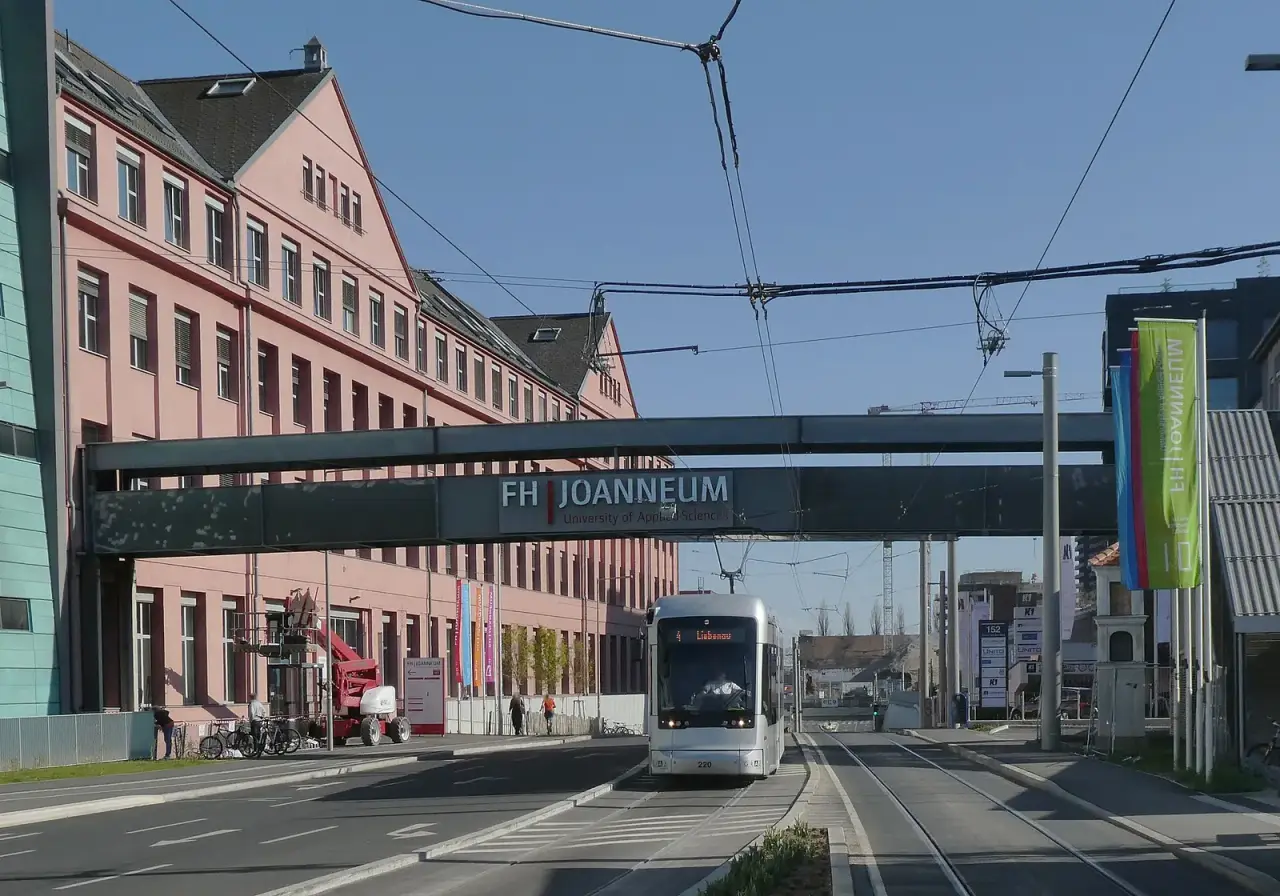
Exam rules sit in each institution's rulebook. The Fachhochschule Act (FHG § 18) gives you 2 retakes of a failed final course exam, the second before an examination panel, and each FH's own rulebook may allow more. FH JOANNEUM, for example, gives every student 3 attempts per exam in total: the first exam, a repeat exam and a committee exam. FH Technikum Wien's rulebook sets a waiting time of 4 weeks after an attempt before a repeat can take place. Read the rulebook of the FH you are considering before you rely on a public university's rules; the guide to academic culture compares attendance and exam rules at several institutions.
Fachhochschule or public university: the comparison
| Fachhochschule (FH) | Public university | |
|---|---|---|
| Orientation | Professional education with a compulsory internship; applied research | Teaching combined with research, emphasis on basic research |
| Admission | Limited places; an entrance procedure for most programmes | Many programmes admit every qualified applicant; caps and procedures in certain fields |
| Cohort and timetable | Fixed group on a set schedule; attendance set per programme | Largely self-organised; you assemble your own timetable |
| Degrees | Bachelor's and master's; no FH doctorate | Bachelor's, master's and doctorate |
| Fees | Up to €363.36 per semester for regular students; cost-covering amounts possible for third-country students | Fixed by law: none for the standard group in the fee-free period, €726.72 per semester for third-country 'Student' permit holders |
If you want maximum flexibility, broad subject choice or a research path, lean to the public universities. If you want a structured, career-ready programme with placements and clear deadlines, a Fachhochschule is often the stronger choice. A third option — private universities — charges its own, uncapped fees and must hold AQ Austria accreditation. Whichever you lean towards, start from the programme and its admission dates, not the institution's name.
Frequently asked questions
Is a Fachhochschule the same as a university in Austria?
Not quite. A Fachhochschule awards the same levels of bachelor's and master's degrees as a university and both are accredited parts of Austrian higher education, but the FH is practice-oriented, runs fixed cohorts with an entrance procedure, and cannot award doctorates. A public university combines teaching with basic research and is the route to a PhD.
How much does a Fachhochschule cost for international students?
Regular students can be charged at most €363.36 per semester, but third-country students on a 'Student' residence permit may be charged cost-covering fees instead, which is why FH prices for non-EU students vary widely — from €726.72 at some institutions to much more at others. Each FH sets its own fee, and the ÖH fee of €26.20 per semester is added on top.
Do I need to take an entrance exam for a Fachhochschule?
Most FH programmes run an admission procedure because places are limited. It typically involves submitting documents, then written or oral tests and an interview. There is no open-access route as at many public university programmes, so you must apply within the FH's own deadline, which can close months before the semester.
Can I study at a Fachhochschule in English?
Yes, but mostly at master's level. Around 80 FH programmes are taught entirely in English, a figure best treated as an order of magnitude, while the large majority of programmes — especially bachelor's — are taught in German.
Can I do a PhD after a Fachhochschule degree?
Yes. A Fachhochschule does not award doctorates itself, but its bachelor's and master's degrees qualify you to apply for a doctoral programme at an Austrian university. Many FH graduates do exactly that, so an FH master's is not a dead end for an academic career.
Sources
14 sources, all official
- FachhochschulenBundesministerium für Frauen, Wissenschaft und Forschung (BMFWF) (Official)
- Fachhochschulgesetz (FHG) § 2 (Erhalter, Studienbeitrag), geltende FassungRIS – Rechtsinformationssystem des Bundes (Official)
- Fachhochschulgesetz (FHG) § 3 (Ziele und leitende Grundsätze), geltende FassungRIS – Rechtsinformationssystem des Bundes (Official)
- Fachhochschulgesetz (FHG) § 4 (Studierende, Zugangsvoraussetzungen), geltende FassungRIS – Rechtsinformationssystem des Bundes (Official)
- Fachhochschulgesetz (FHG) § 8 (Akkreditierungsvoraussetzungen, Bezeichnung), geltende FassungRIS – Rechtsinformationssystem des Bundes (Official)
- Zahlen-Daten-Fakten: FH-Sektor (Stand Jänner 2025, PDF)FHK – Österreichische Fachhochschul-Konferenz (Official)
- Fachhochschulen/Hochschulen für Angewandte Wissenschaften: Lehre und Forschung — Zahlen, Daten, Fakten (September 2026, PDF)FHK – Österreichische Fachhochschul-Konferenz (Official)
- University of Applied SciencesOeAD – Study in Austria (Official)
- Statistisches Taschenbuch – Hochschulen und Forschung 2025 (Tabellen 1.1, 1.16, 2.1, 2.4)Bundesministerium für Frauen, Wissenschaft und Forschung (BMFWF) (Official)
- Orientation Days 2025: The World Arrives at MCIMCI Innsbruck (Management Center Innsbruck) (Official)
- BibliotheksausweisUniversitäts- und Landesbibliothek Tirol, Universität Innsbruck (Official)
- Fachhochschulgesetz (FHG), konsolidierte FassungRechtsinformationssystem des Bundes (RIS) (Official)
- Studien- und Prüfungsordnung der FH JOANNEUM, Version 1.6 vom 08.09.2023FH JOANNEUM (Official)
- Satzungsteil Studienrechtliche Bestimmungen / Prüfungsordnung, Version 20 vom 04.06.2025FH Technikum Wien (Official)