The DAAD describes the German model in one sentence: you are given a good amount of freedom to personalise your study experience, and in return you must take care of more tasks yourself, such as registering for classes and exams. Nobody will remind you of a registration window or check whether you came to a lecture. The flip side is that the expectations, once they apply, are firm: a term paper is an independent piece of academic writing, an exam tests a whole semester, and copying without attribution has consequences that can reach a fine or the loss of a degree. This guide explains the formats, the unwritten habits and the written rules.
For the structure of degrees and credits behind all of this, see the study overview; for exam attempts and deadlines, exams and retakes in Germany.
Freedom with responsibility: how German study is organised
Programmes are built from modules, and each module's description lists its content, prerequisites, workload and the assessment that earns the credits (MRVO § 7). Within the structure your programme sets, you put together your own timetable each semester. One ECTS credit represents 25 to 30 hours of work, and a semester is planned at 30 ECTS credits per semester, so even a week with few contact hours is a full-time week once reading, exercises and writing are counted. DAAD's advice to plan several weeks of preparation for an exam follows from that arithmetic.
| Format | German term | What happens | What is expected |
|---|---|---|---|
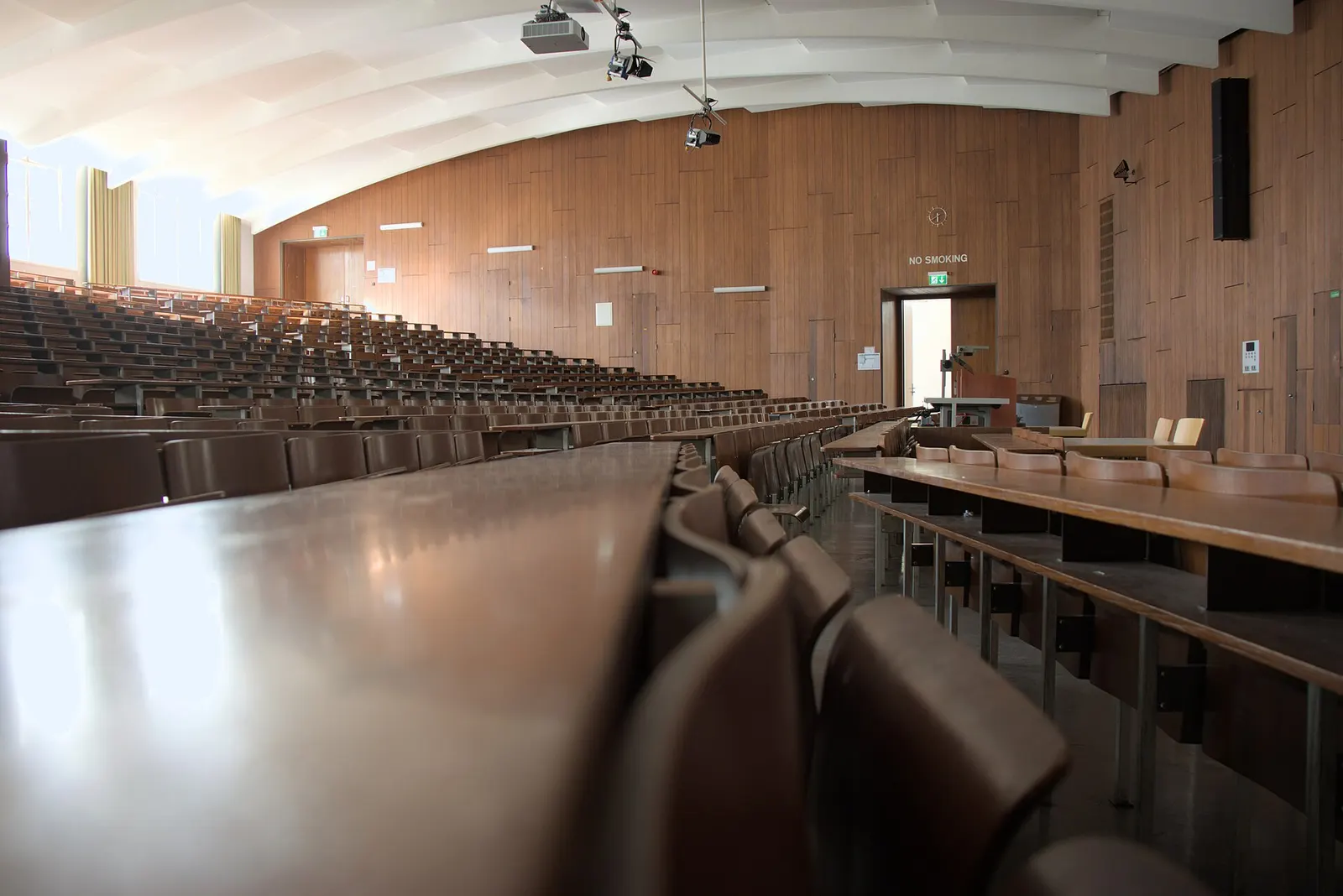
| Lecture | Vorlesung | A professor presents; large audiences; DAAD: 'little room for discussions' | Listen, take notes, ask questions when invited; prepare and revise on your own |
| Seminar | Seminar | Small group; discussion of texts and topics | Active participation, a presentation (Referat) and usually a term paper (Hausarbeit) |
| Exercise class | Übung | Practical part supplementing lecture content, often problem sheets | Solve and hand in problems, sometimes as a condition for exam admission |
| Tutorial | Tutorium | Led by a tutor, deepens lecture material | Voluntary in many programmes; the place to ask what you did not dare ask in the lecture |
| Laboratory, excursion, practical | Praktikum, Exkursion | Hands-on work in groups | Attendance can be compulsory here (see below) |
- Term paperHausarbeit
- In DAAD's words, term papers are longer, independently written documents in which you critically analyse an academic topic. They are usually much shorter than a thesis, but DAAD advises giving yourself plenty of time. Many seminars make the Hausarbeit the graded assessment, with the Referat as a condition for being allowed to write it.
- PresentationReferat
- A talk on a topic agreed with the lecturer in advance, delivered in a seminar and often followed by discussion. Paderborn University's handout for international students lists giving presentations and contributing to group work among the skills seminars require.
Is attendance mandatory at German universities?
Mostly not for lectures, and the limits are written into state law in some Länder. North Rhine-Westphalia's higher education act allows a programme to make attendance a condition only if the examination regulations themselves say so, only where attendance is suitable, necessary and appropriate for that course's learning objective, which the act says is the case in particular for excursions, practicals, practical exercises and comparable courses, and only if the regulations also define harmless absences such as illness, care for a relative or childcare (HG NRW § 64(1)). Seminars, on the other hand, work through participation: whether or not attendance is formally required, a Referat and a Hausarbeit cannot be done from a distance. DAAD puts the general rule simply: you must attend the compulsory courses and pass the examination as well.
Professors, office hours and the academic quarter
Professors usually hold a weekly consultation hour, the Sprechstunde, in which they answer students' questions about term papers and the course; apart from office hours and class times, DAAD notes, you can contact most teaching staff by email. Use the Sprechstunde for anything that needs a decision, such as a term-paper topic, a thesis proposal or a reference letter, and keep emails short and specific. One habit that confuses newcomers is the academic quarter: Paderborn University's international office explains that classes at many German universities start fifteen minutes after the hour, so '9 Uhr c.t.' (cum tempore) means 9.15 and '9 Uhr s.t.' (sine tempore) means 9.00 sharp.
- Office hourSprechstunde
- A fixed weekly slot in which a professor or lecturer is available to students. Some lecturers ask you to book by email or on a list; others keep it open. It is the normal route for individual questions, not a sign that something is wrong.
Exams, self-study and what 'knowing the material' means
To obtain ECTS credits you must take some form of examination in most courses, and DAAD stresses that you are not automatically registered for exams but have to sign up separately, usually online; the deadlines are in the examination regulations or on the programme's website. In most cases the content of an entire semester is tested, and DAAD suggests planning several weeks of studying and preparation. The practical side, from registration windows to retakes and the final attempt, is in exams and retakes in Germany; how grades are given and averaged is in the German grading system.
Two features of the system protect students and are worth knowing. In North Rhine-Westphalia, exam dates must take account of students' religious freedom (HG NRW § 63(3)), and students of the same programme may sit in as listeners at oral exams unless a candidate objects (§ 63(4)), which is a good way to see what an oral exam looks like before your own. Both are state rules; other Länder have their own.
Plagiarism and cheating: what the rules say
Academic honesty is a legal duty, not only a convention. North Rhine-Westphalia's act obliges all researchers and all students to scientific honesty and to the generally recognised principles of good scientific practice (HG NRW § 4(4)). The consequences for students sit in two places: the examination regulations, which decide what happens to the exam, and state law, which adds fines and exmatriculation. Universities also check submitted work with software. TUM's general regulations state that work may be checked for unmarked copied passages, that submitting an exam counts as consent to the check, and that an anonymised digital copy must be provided on request (APSO § 22).
| Rule | TUM (APSO § 22) | North Rhine-Westphalia (HG NRW) |
|---|---|---|
| Effect on the exam | the exam is graded 'nicht ausreichend' (5.0); serious or repeated cases can end the programme as definitively failed; an exam failed for cheating can be retaken only once | Set by each university's examination regulations (§ 64(2) no. 9) |
| Fine | — | Intentional breach of an exam regulation's deception rules is an administrative offence, fine up to €50,000, prosecuted by the university's chancellor (§ 63(5)) |
| Exmatriculation | Exclusion from further exams in the programme in serious or repeated cases, which counts as a definitive fail | Possible after multiple or otherwise serious deception (§ 63(5)); the university may then bar re-enrolment for up to 2 years (§ 51(4), new in 2026) |
| Statutory declaration | — | Universities may require a Versicherung an Eides Statt that the work is the candidate's own (§ 63(5)); a knowingly false one is a crime, up to 3 years in prison (StGB § 156), negligent up to one year (§ 161) |
| Degree already awarded | — | A bachelor's or master's award may be revoked within 5 years of the award (§ 66(4)); see the 2026 rules below |
- Statutory declarationVersicherung an Eides Statt
- A formal declaration made to a body authorised to take it, with criminal liability for falsehood. HG NRW § 63(5) authorises universities and state examination offices to require one for exam work; a knowingly false declaration carries up to 3 years in prison or a fine, a negligent one up to one year.
North Rhine-Westphalia's 2026 academic-integrity rules
An amending Act of 21 July 2026, in force since 4 August 2026, added a new Part 10 (§§ 84–100) to NRW's higher education act under the heading of a safe and honest university. For students the changes are mostly indirect. The new integrity procedure (§ 86) targets breaches of good scientific practice by members of the university, with measures that range from a formal reprimand to the withdrawal of a degree awarded for work that did not meet the rules of good scientific practice (§ 86(2) no. 10). Two points matter for anyone writing a thesis or a dissertation in NRW: there is no general time bar on these measures (§ 86(4)), although a university's doctoral or other regulations may set one, and the five-year limit for revoking a bachelor's or master's award under § 66(4) is expressly left untouched. A student's dishonesty inside an exam, including a thesis, stays under the examination regulations (§ 86(3)).
The same Act rewrote the rules on disciplinary breaches (§ 51a), covering violence and serious disruption, and added the two-year re-enrolment ban that can accompany an exmatriculation for cheating (§ 51(4)). It also reformulated § 63(5), the provision on statutory declarations and the €50,000 fine. These are NRW rules. Other Länder have their own acts with different wording and different fines; only NRW's text was read for this guide.
Generative AI is not mentioned in the federal framework or in NRW's act as read, and neither the KMK ordinance nor the TUM and RWTH regulations consulted set a national line. Whether and how you may use AI tools for a term paper is decided by each university and often by each examiner; TUM's rule that work is checked for unmarked copied passages, and the declaration you sign, apply regardless. Ask before you submit, not after.
In practice: a seminar term from first session to term paper
Register for the course in the portal
Seminars often have limited places and a registration window before the semester; the first session (Vorbesprechung) assigns presentation topics and dates.
Prepare your Referat
Agree the topic with the lecturer, use the Sprechstunde to check your outline, and expect a discussion afterwards.
Register for the assessment separately
The Hausarbeit or exam that carries the credits needs its own registration in the exam portal; the course registration does not cover it.
Write the Hausarbeit
Follow the department's style sheet for citations. Every quotation, paraphrase and figure needs a source; software will compare your text with published work.
Sign the declaration and submit on time
Submit in the required form (upload or print) by the deadline, with the signed declaration of independent work. What a late submission means is set in your examination regulations; read that rule before the deadline, not after.
Habits that keep you out of trouble
- Keep a running list of every source you read, with page numbers, from the first day of research.
- Check your examination regulations before reusing text from an earlier paper of your own, and ask the examiner if in doubt.
- Ask in the Sprechstunde what counts as allowed help: proofreading, a friend's feedback, AI tools.
- Store drafts and notes until the grade is final, in case the examiner asks how the work was produced.
- Read the paragraph on 'Täuschung' in your examination regulations before your first submission.
Academic culture connects to almost every other part of student life. How exams and retakes work is explained in exams and retakes, how your work is marked in the German grading system, and how the year is structured in the academic calendar. If you are still choosing, compare bachelor's and master's study, and read everyday cultural norms for life outside the lecture hall.
Frequently asked questions
Is attendance mandatory at German universities?
Usually not for lectures. North Rhine-Westphalia's act allows compulsory attendance only where the examination regulations prescribe it and it is necessary for the course, such as excursions, practicals and lab exercises, and only with rules for harmless absences. Seminars require participation in practice, and compulsory courses must be attended and passed.
What is a Hausarbeit?
A term paper: in DAAD's words, a longer, independently written document in which you critically analyse an academic topic. It is usually the graded assessment of a seminar, shorter than a thesis but written to the same standards of citation, and it is checked with plagiarism software at many universities.
What happens if I am caught plagiarising in Germany?
At least a failed exam: at TUM, the exam is graded 'nicht ausreichend' (5.0); serious or repeated cases can end the programme as definitively failed. In North Rhine-Westphalia intentional deception is also an administrative offence with a fine of up to €50,000, repeated or serious cases can lead to exmatriculation with a re-enrolment ban of up to 2 years, and a false statutory declaration is a crime.
What does 'c.t.' mean on a German timetable?
Cum tempore: the class starts fifteen minutes after the stated hour, the so-called academic quarter, so '10 Uhr c.t.' is 10.15. 'S.t.' (sine tempore) means it starts exactly on the hour. Paderborn University's handout for international students explains the convention; check whether your exam times carry c.t. or s.t.
Can a German university take my degree away for plagiarism years later?
In North Rhine-Westphalia a bachelor's or master's award can be revoked within 5 years of the award, with the time of any revocation procedure not counted. Since August 2026 the state's new integrity rules also allow withdrawal of a degree obtained through work that breached good scientific practice, with no general time bar, unless the university's own regulations set one. Other states have their own rules.
How much self-study is expected at a German university?
A lot. One ECTS credit stands for 25 to 30 hours of total work and a semester for 30 ECTS credits per semester, so most of your week is reading, preparing and writing outside the lecture hall. In many courses the exam or paper at the end is the main assessment. See exams and retakes.
Sources
8 sources, 7 official
- Good to Know – The Basics (credits, courses, exams, office hours, term papers)DAAD (Official)
- Living and Studying in Germany – an Intercultural Workshop: German Academic Culture (handout for exchange students)Paderborn University, International Office (Institutional)
- Musterrechtsverordnung gemäß Artikel 4 Absätze 1–4 Studienakkreditierungsstaatsvertrag (Beschluss der Kultusministerkonferenz vom 07.12.2017)Kultusministerkonferenz (KMK) (Official)
- Gesetz über die Hochschulen des Landes Nordrhein-Westfalen (Hochschulgesetz – HG), Fassung gültig ab 4. August 2026Land Nordrhein-Westfalen (recht.nrw.de) (Official)
- Allgemeine Prüfungs- und Studienordnung für Bachelor- und Masterstudiengänge an der TUM (APSO) vom 18. März 2011, lesbare Fassung der 12. Änderungssatzung vom 16. Dezember 2025Technical University of Munich (TUM) (Official)
- Examination regulations – ÜPO (non-binding English translation of key sections, incl. § 10 grading and § 14 failed examinations)RWTH Aachen University (Master programme page) (Official)
- Strafgesetzbuch (StGB) § 156 Falsche Versicherung an Eides StattBundesministerium der Justiz / gesetze-im-internet.de (Official)
- Strafgesetzbuch (StGB) § 161 Fahrlässiger Falscheid; fahrlässige falsche Versicherung an Eides StattBundesministerium der Justiz / gesetze-im-internet.de (Official)