TU Berlin at a glance
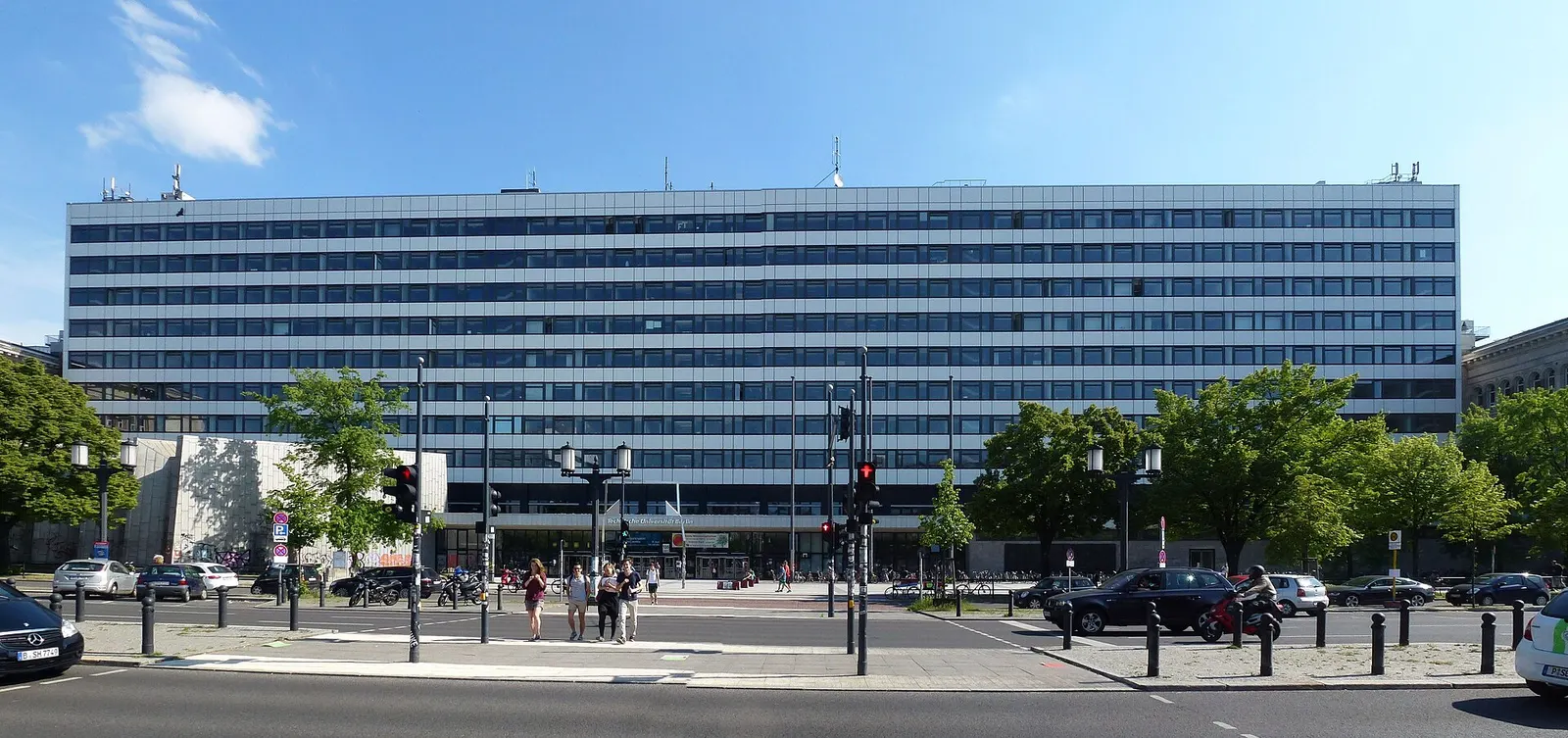
Technische Universität Berlin traces its direct predecessor to 1879 (reopened in 1946 as Technische Universität), and in 1946 it was the first German institution to carry the name 'Technische Universität'. It is a member of TU9 and, with Freie Universität and Humboldt-Universität, of the Berlin University Alliance, the capital's joint excellence site whose funding continues from 2027. Seven faculties cover the humanities and education, mathematics and natural sciences, process sciences, electrical engineering and computer science, mechanical engineering and transport, planning and building, and economics and management. Its main building is at Straße des 17. Juni 135 in Charlottenburg.
| Item | What the sources say |
|---|---|
| Founded | 1879 (reopened in 1946 as Technische Universität) |
| Students, TU Berlin's own statistics, winter semester 2025/26 | 33,990 |
| Students, statistical office, winter semester 2025/26 | 34,475 |
| Alliances and labels | TU9; Berlin University Alliance (Excellence Strategy), funding continued from 1 January 2027 |
| THE World University Rankings 2027 | =171 (joint rank) |
| Master's taught in English (programme list) | 19 master's programmes; 6 more in German and English |
| Application route for a foreign degree | VPD from uni-assist, then application in the TU portal (tuPORT) |
| Semester fee, winter semester 2026/27 | €379.06 per semester, including the Deutschlandsemesterticket; no tuition component |
Both counts include Turkish citizens who went to school in Germany among the 'foreign' students, so neither says how many international students in the DAAD sense are enrolled. The comparison with other universities is on the universities hub.
Which master's TU Berlin teaches in English
TU Berlin's programme list has a language filter. With 'Master' and 'English' selected it showed 19 master's programmes on 30 October 2026; a handful more were marked German and English, and the large majority German. Three of the English programmes are MBAs and one is a Master of Business Law, continuing-education degrees with their own fees and admission rules. The regular English-taught M.Sc. programmes are the ones below.
| Field | Programmes | Admission |
|---|---|---|
| Computing and data | Computer Science (Informatik); Information Systems Management (Wirtschaftsinformatik); Scientific Computing; Computational Neuroscience | Computer Science open; the others restricted |
| Engineering | Civil Systems Engineering; Global Production Engineering; Space Engineering; Environmental Science and Technology; Polymer Science (joint with HU, FU and Potsdam) | Mostly restricted |
| Planning and environment | Urban Design; Urban Management; Environmental Planning; Architecture Typology; Geodesy and Geoinformation Science | Restricted (Architecture Typology not offered in winter 2026/27) |
| Management and law | Innovation Management, Entrepreneurship, and Sustainability; Building Sustainability (MBA); Energy Management (MBA); Sustainable Mobility Management (MBA); European and International Energy Law (MBL) | Restricted; the MBAs and MBL are fee-based continuing education |
Mechanical engineering, electrical engineering and most of the classical engineering master's are taught in German, so an engineer without German has a narrower choice here than at RWTH Aachen or TUM. For the national picture, see English-taught programmes in Germany.
How admission works: VPD first, then tuPORT
Since summer semester 2026, every master's applicant whose first degree comes from a foreign university, or who is about to finish one and applies with an ECTS certificate, needs a VPD (preliminary review documentation) from uni-assist, requested specifically for TU Berlin. Without it the application is formally incomplete and rejected. Bachelor's applicants with a foreign school certificate need a VPD too. The VPD is valid for one year, can be requested all year round, and the deadlines for applicants with foreign credentials are the same as for everyone else.
Request the VPD at uni-assist
In the My assist portal choose 'Technische Universität Berlin' and 'Master's (all subjects)', upload your documents and pay uni-assist's fee (€75 for the first programme of a semester). Request it as early as possible: processing can take several weeks. See uni-assist and the VPD.
Get access to the TU portal (tuPORT)
Create an applicant account well before the deadline. Near the end of the period the server can be overloaded, and TU Berlin accepts no application without portal access.
Apply in the 'Study & Teaching' app
Create a new application for your programme and upload every document from TU Berlin's checklist: the VPD, degree certificate and transcript (or an ECTS certificate with your current credits and GPA), the study and examination regulations and module descriptions of your bachelor's with the relevant sections highlighted, programme-specific proofs such as English, the declaration of study history, a current enrolment or de-registration certificate, and your passport data page marked as a copy.
Formal review, then the examination board
TU Berlin first checks completeness, then the faculty's board checks whether your bachelor's meets the programme's content requirements. Restricted programmes then run a selection among those who qualify.
Offer, acceptance, enrolment
An offer of a place appears in tuPORT; accept it within the deadline or it lapses. There are no conditional admissions: every requirement must be proven by the application deadline.
| Semester | Restricted admission | Open admission |
|---|---|---|
| Summer semester 2027 | 1 December 2026 – 15 January 2027 | 1 December 2026 – 28 February 2027 |
| Winter semester 2026/27 (closed; pattern for 2027/28) | English-language programmes 1 April – 15 May 2026 | 1 June – 31 August 2026 |
- tuPORTTU-Portal (tuPORT)
- TU Berlin's online portal. Applications are created in its 'Study & Teaching' app, the application status and the admission or rejection letter appear there, and after enrolment it shows your fees and documents.
If you are applying from Türkiye
- Master's: the examination board judges content, so upload the module descriptions of your Turkish bachelor's in English or German with the relevant parts marked. Your university's anabin status should be H+; see recognition.
- Translations: uni-assist accepts Turkish translations only from a sworn translator (yeminli tercüman). TU Berlin asks for official translations of anything not in German or English.
- Bachelor's: anabin and DAAD Türkiye give a Lise Diploması direct access only with a YKS placement in a four-year, face-to-face (örgün) lisans programme and more than 180 points (170 for the 2020 exam) in score type SAY, SÖZ, EA or DİL, for the same or a related subject; anabin lists no Studienkolleg route for the Lise Diploması alone. See the YKS requirement.
- English: proof is programme-specific and an English-medium Turkish degree does not automatically count; see language requirements.
What TU Berlin costs: the semester fee
TU Berlin's fee schedule for winter semester 2026/27 contains no tuition: the €379.06 per semester is made up of Berlin-wide components (administrative fee 50.00, student body 14.56, studierendenWERK Berlin 85.00, Deutschlandsemesterticket 226.80, semester-ticket social fund 2.70). Payment is by bank transfer only, with the personal reference from tuPORT, never in cash or instalments; the amount must be on TU Berlin's account by the deadline, and transfers from abroad can lose bank charges on the way.
Semester contribution: the transport ticket makes the difference
€ per semester · winter semester 2026/27
Every student pays a semester contribution each semester: from €97 at LMU Munich and €189.80 at Heidelberg, which include no transport ticket, to €408.28 at Goethe University Frankfurt and €453.16 in Hannover.
- Leibniz University Hannover€453.16
- Goethe University Frankfurt€408.28
- TU Darmstadt€402.68
- University of Hamburg€402
- TU Berlin€379.06
- FU Berlin€376.80
- TU Dresden€361
- University of Cologne€355.65
- Leipzig University€332.30
- Heidelberg University (no ticket)€189.80
- LMU Munich (no ticket)€97
| Item | Value |
|---|---|
| Leibniz University Hannover | €453.16 |
| Goethe University Frankfurt | €408.28 |
| TU Darmstadt | €402.68 |
| University of Hamburg | €402 |
| TU Berlin | €379.06 |
| FU Berlin | €376.80 |
| TU Dresden | €361 |
| University of Cologne | €355.65 |
| Leipzig University | €332.30 |
| Heidelberg University (no ticket) | €189.80 |
| LMU Munich (no ticket) | €97 |
Most of the gap is the Deutschlandsemesterticket (€226.80 per semester), included everywhere shown except Heidelberg and LMU Munich. Amounts as each university states them, with any Land administrative fee; Heidelberg's is the figure its fees page called current on 30 October 2026.
Source: LMU Munich, Studierendenwerk München Oberbayern, TUM +14 more. Last checked:
Image (PNG)| Rule | Detail |
|---|---|
| Total | €379.06 per semester |
| Administrative fee | €50 per semester; TU Berlin waives it, on application each semester, only for refugees receiving asylum-seeker benefits or holding certain protection-related permits |
| Deutschlandsemesterticket | Part of the fee: €226.80 per semester of the total, plus a small social-fund contribution; students in hardship can apply to the AStA for a subsidy |
| Late re-registration | €19.94 on top if you pay after the deadline in the reminder; without the full amount, re-registration is not possible |
Continuing-education master's such as the MBAs charge their own programme fees on top. See the semester contribution and the Deutschlandsemesterticket.
Living in Berlin as a TU student
Berlin has 202,558 students at its universities and colleges, the most of any German city, and the largest Turkish community in Germany: 82,146 residents with Turkish citizenship at the 2022 census. Average net cold rent was €7.67 per m² a month in 2022, but newcomers face asking rents: the median shared-flat room cost €650 per month in winter semester 2026/27. A studierendenWERK BERLIN hall place averaged €336.56 per month in 2024, with a deposit of 1.5 monthly rents and a minimum stay of 3 months. See studying in Berlin and student dormitories.
Rent per square metre in the big student cities
Average net cold rent in existing tenancies, € per m² a month · census, 15 May 2022
In the 2022 census, tenants paid an average net cold rent of €12.89 per square metre in Munich, €10.58 in Frankfurt and €10.39 in Stuttgart, against €7.28 across Germany, €6.92 in Dresden and €6.44 in Leipzig.
- Munich€12.89
- Frankfurt€10.58
- Stuttgart€10.39
- Heidelberg€10.02
- Cologne€9.39
- Hamburg€9.16
- Aachen€8.04
- Berlin€7.67
- Germany€7.28
- Dresden€6.92
- Leipzig€6.44
| Item | Value |
|---|---|
| Munich | €12.89 |
| Frankfurt | €10.58 |
| Stuttgart | €10.39 |
| Heidelberg | €10.02 |
| Cologne | €9.39 |
| Hamburg | €9.16 |
| Aachen | €8.04 |
| Berlin | €7.67 |
| Germany | €7.28 |
| Dresden | €6.92 |
| Leipzig | €6.44 |
Rents in existing tenancies, before heating and other running costs. A newcomer is asked more, most visibly in Berlin; for a student room, the WG medians are the better guide.
Source: Statistische Ämter des Bundes und der Länder. Last checked:
Image (PNG)Asking rents set the budget. With a shared-flat room at the Berlin median, a TU student's fixed monthly costs (rent, student health insurance, the semester-ticket share and a third of the broadcasting fee) come to about €842.01 per month; with a hall place at the 2024 average, about €540.81 per month. The blocked-account payout in 2026 is €992 per month a month, so the shared-flat route leaves little for food. See the cost of living for the remaining items.
Student jobs at the university
Many TU students close the gap with a job as a student assistant (studentische Beschäftigte) in an institute, a lab or the library. In Berlin these jobs fall under a collective agreement for all the city's higher education institutions, TV Stud III. After the agreement of June 2026 the hourly wage is €15.08 per hour retroactively from January 2026, rising to €15.90 per hour from January 2027, which is above the general minimum wage of €13.90 gross per hour. Positions are advertised by the university and its institutes, and a contract specifies the hours you work. Non-EU students may work within the annual limit of 140 days of work per calendar year or 280 half days per calendar year, but a student-related side job (studentische Nebentätigkeit), which a job as a student assistant at the university usually is, is not counted against it; check with the immigration office if in doubt. See student assistant jobs and working hours for students.
TU Berlin in the rankings
In the Times Higher Education World University Rankings 2027 (published 30 September 2026, checked 30 October 2026) TU Berlin holds the joint position =171, lower than in the two previous editions. QS's 2027 position could not be verified because QS blocks automated access. For the Berlin University Alliance's three universities, subject strengths differ far more than overall ranks suggest; see how to read the rankings.
In practice: timing a TU Berlin application from abroad
Work backwards from the application period. uni-assist needs weeks, so request the VPD before the period even opens; it can be used for several semesters within its year of validity, but only for one TU Berlin application per semester. Choose that one programme carefully: if you are unsure between an open and a restricted programme, remember that the open-admission period runs longer, while the restricted period for English programmes closed in mid-May for winter 2026/27.
After an offer, the enrolment documents and the first semester fee must be in on time, and TU Berlin stresses that even a successful transfer does not complete enrolment if a required document is missing. Its Office of Student Affairs holds online office hours, and the Academic Advising Service covers programme choice. For the visa, see applying from Türkiye.
Before you apply to TU Berlin
- VPD requested at uni-assist for 'Technische Universität Berlin', 'Master's (all subjects)'
- tuPORT applicant account created before the application period
- Checklist documents as PDFs: transcript, module descriptions with relevant sections highlighted, declaration of study history, passport copy
- English proof as required by the programme
- One programme chosen for this semester
- Berlin budget: semester fee, deposit, and asking rents far above the census average
Frequently asked questions
How do I apply to TU Berlin?
With a foreign bachelor's, first request a VPD from uni-assist for TU Berlin, then create an account in the TU portal (tuPORT) and submit one online application with all checklist documents within the application period. The faculty's examination board checks your bachelor's content, and restricted programmes select among qualified applicants.
Does TU Berlin use uni-assist?
Yes, for the preliminary review: since summer semester 2026 applicants with a foreign first degree need a VPD from uni-assist, requested specifically for TU Berlin. The application itself is then made directly in tuPORT, not through uni-assist.
Does TU Berlin offer English-taught master's?
Yes. Its programme list marked 19 master's programmes as taught in English on 30 October 2026, among them Computer Science, Scientific Computing, Global Production Engineering, Space Engineering, Urban Design and Environmental Planning, plus three MBAs and a Master of Business Law. Most classical engineering master's are in German.
Is TU Berlin tuition-free for international students?
Its fee schedule contains no tuition: all students pay the semester fee of €379.06 per semester for winter semester 2026/27, which includes the Deutschlandsemesterticket. Continuing-education master's charge their own programme fees.
When is the TU Berlin application deadline for a master's?
For summer semester 2027, restricted programmes 1 December 2026 – 15 January 2027 and open programmes 1 December 2026 – 28 February 2027. For winter 2026/27, English-language restricted programmes ran 1 April – 15 May 2026; the 2027/28 dates were not yet published on 30 October 2026.
How much does a student assistant job at TU Berlin pay?
Student assistant jobs at Berlin's universities fall under the TV Stud III collective agreement. Since the June 2026 agreement the hourly wage is €15.08 per hour, applied retroactively from January 2026, and it rises to €15.90 per hour from January 2027. Your contract sets your working hours.
Sources
24 sources, 22 official
- History of the UniversityTechnische Universität Berlin (Official)
- TU Berlin StatisticsTechnische Universität Berlin (Official)
- Applying with a primary university degree from a foreign universityTechnische Universität Berlin (Official)
- Dates & Deadlines for application and enrollment at TU BerlinTechnische Universität Berlin (Official)
- Semester FeesTechnische Universität Berlin (Official)
- All Programs Offered – filters: Master, language of instruction EnglishTechnische Universität Berlin (Official)
- Technische Universität Berlin (TU Berlin) – uni-assist university entryuni-assist e.V. (Official)
- Technical University of Berlin – World University Rankings profileTimes Higher Education (THE) (Institutional)
- TU9 – Allianz führender Technischer Universitäten in DeutschlandTU9 German Universities of Technology e.V. (Official)
- Zehn Exzellenzstandorte werden weitergefördert (Gemeinsame Pressemitteilung von WR und DFG, 11. März 2026)Wissenschaftsrat / Deutsche Forschungsgemeinschaft (Official)
- Pay and submit (handling fees)uni-assist e.V. (Official)
- Info country by country – Turkeyuni-assist e.V. (Official)
- Almanya'da yükseköğrenim (lisans ve master başvurusu)DAAD Türkiye (DAAD Information Centres Istanbul/Ankara) (Official)
- Pressemitteilung: Studentische Wohnkosten Wintersemester 2026/2027 (19 September 2026)Moses Mendelssohn Institut (with WG-Gesucht.de) (Institutional)
- FAQ Wohnen (Kaution; Wann weiß ich, ob es mit einem Platz klappt?; Wohnberechtigung; Mindestwohnzeit; Wie bewerbe ich mich um einen Wohnplatz?)studierendenWERK BERLIN (Official)
- Schriftliche Anfrage Drucksache 19/22916: Studentisches Wohnen in Berlin (Antwort vom 26. Juni 2025)Abgeordnetenhaus Berlin / Senatsverwaltung für Wissenschaft, Gesundheit und Pflege (Official)
- Statistischer Bericht – Statistik der Studierenden – Wintersemester 2025/2026 (Tabellen 21311-01 und 21311-12)Statistisches Bundesamt (Destatis) (Official)
- Zensus 2022, Tabelle 4000W-0004: Wohnungskennzahlen – Durchschnittliche Nettokaltmiete (Gemeinden, Stichtag 15.05.2022)Statistische Ämter des Bundes und der Länder (Zensusdatenbank) (Official)
- Zensus 2022, Tabelle 1000A-1021: Personen – Staatsangehörigkeit (Häufigste Länder), Gemeinden, Stichtag 15.05.2022Statistische Ämter des Bundes und der Länder (Zensusdatenbank) (Official)
- anabin – Türkei: Lise Diplomasi einer 12-jährigen allgemeinbildenden Sekundarschule (Bewertung mit Fallgruppen TUR-BV05 bis TUR-BV08 und TUR-BV14)Kultusministerkonferenz – Zentralstelle für ausländisches Bildungswesen (anabin) (Official)
- Studentische Beschäftigte erhalten mehr GeldHochschule für Wirtschaft und Recht Berlin (Official)
- Schriftliche Anfrage Drucksache 19/22916: Studentisches Wohnen in Berlin (Antwort vom 26. Juni 2025)Abgeordnetenhaus Berlin / Senatsverwaltung für Wissenschaft, Gesundheit und Pflege (Official)
- Kosten & Beitrag zur studentischen KrankenversicherungAOK-Bundesverband (statutory health insurance) (Official)
- Informationen für StudierendeARD ZDF Deutschlandradio Beitragsservice (rundfunkbeitrag.de) (Official)